Category: Category Explainers

  • The Authority Triangle: a full teaching piece

    I have spent twenty-five years watching strong experts run into the same wall. They have real work. They get visibility for it — podcasts, stages, social, PR. And still, the business does not compound the way the visibility suggests it should. The pattern is not a quality problem. It is an architecture problem.

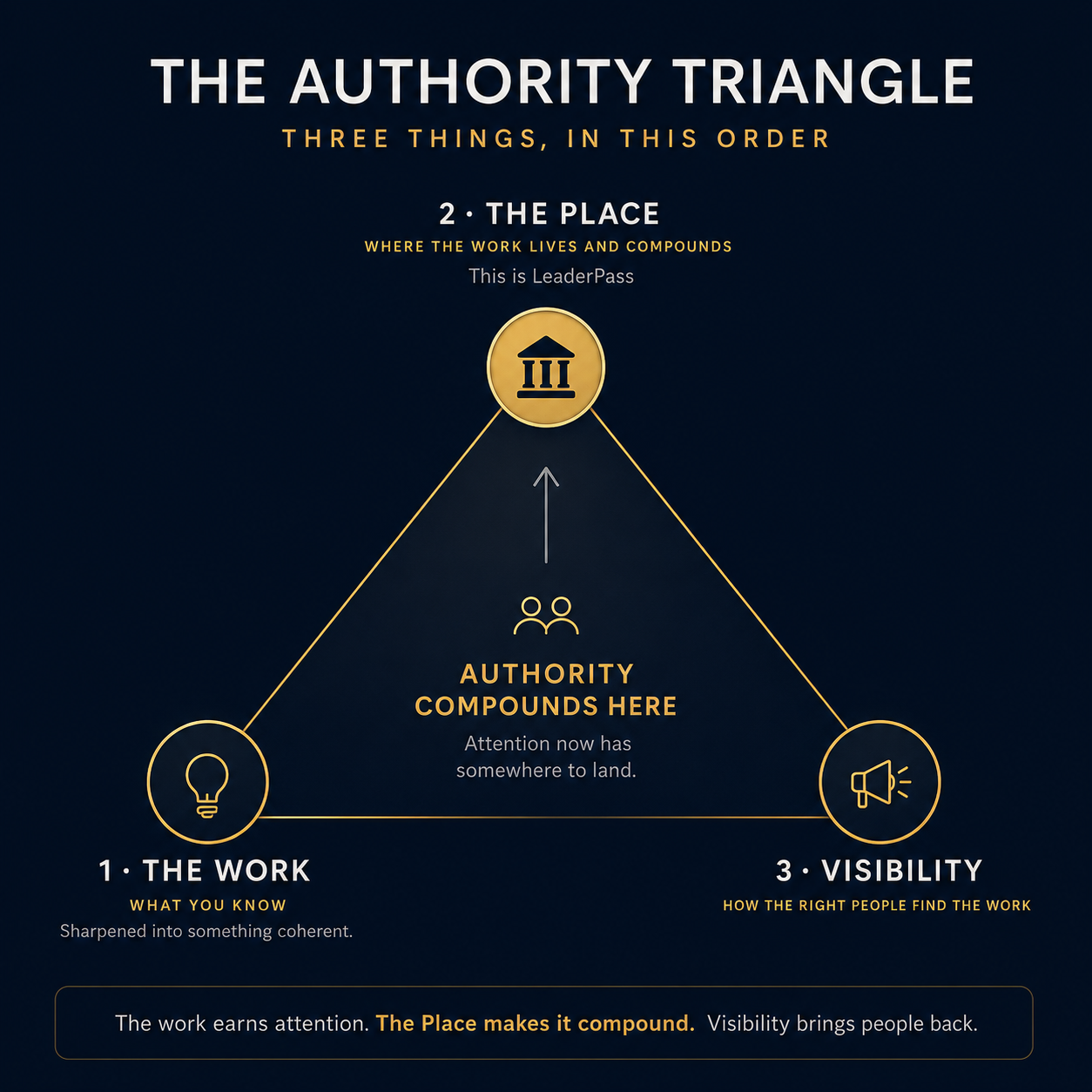
    The Authority Triangle names the three things every expert needs and the order they have to be built in for the architecture to do its job. The Work, the Place, and Visibility. Three things. One specific order. The order is not a preference. It is the mechanism that determines whether attention compounds into authority or leaks into the next platform’s algorithm.

    If you are new to the framework, What is the Authority Triangle? is where to start. That piece introduces the three layers in about 1,500 words. This one is the canonical reference for readers who want the full teaching — the diagnostic logic, the integration architecture, the depth of each layer, and what it means to build all three as a connected whole.

    The Work

    The Work is what you know, sharpened into something coherent. Your point of view, your method, your proof, your promise.

    That definition matters precisely because it says sharpened. The Work is not a topic area or a credential. A lot of experts in any given field have the same general territory. The Work is what you have done with yours — the specific position you have taken, the framework you have built from observation, the argument you can make that nobody else can make the same way.

    This is not a quality question, and it is not a quantity question. The Work is not about how much an expert knows or how much they have produced. It is about whether the body of knowledge has a center. Whether someone could return to it, pull from it, and describe what they got from it. Whether the core argument stays the same whether the expert is in a room of twenty or a room of two hundred.

    Many experts have knowledge and do not have Work in this sense. They have positions on many topics, strong opinions across a wide range, depth in several areas. What they do not have is a single through-line that the audience can grab. The audience walks away from the keynote feeling something happened. They cannot tell a colleague what it was. They liked the speaker. They cannot repeat what the speaker said.

    That is a Work problem. And no visibility spend resolves it.

    When the Work is clear, it does something specific: it becomes repeatable by others. An audience member can explain it to someone who was not in the room and the meaning does not change in the transfer. The point of view is distinct enough that it arrives with the expert’s fingerprint even when the expert is not in the conversation. That is the test. Not the talk, not the feedback, not the reviews. Does the idea survive the transfer?

    Blueprinting — the diagnostic process inside LeaderPass Lab — is where the Work gets sharpened for the environment. Not authored. The expert brings the expertise. Blueprinting decides what form the Work should take so the Place can hold it and the audience can return to it.

    The Place

    The Place is the environment where an expert’s body of work lives so people can return to it, trust it, and use it over time.

    That definition is doing several things at once. Return, trust, use. All three.

    Return means the Place has to be worth coming back to, and structured so coming back is easy. A Place someone visits once is not performing its job. The compounding that every expert wants from their body of work happens in the second visit, the fifth visit, the moment three months after a talk when someone is in a situation where what the expert taught becomes relevant and they know exactly where to go.

    Trust is what the environment signals before anyone opens anything. Before a visitor reads a word or watches a minute of content, the surrounding architecture has already told them whether this is a place worth taking seriously. A branded, well-produced environment with clear navigation and a coherent body of work communicates something. A scattered set of links, a generic course platform with someone else’s template, a website that looks like every other expert’s website, communicates something else. The audience reads the Place before they read the content. The Place is the first argument for whether the expert’s work deserves their attention.

    Use means the Place is structured around real situations, not a completion path. A Place people use is one they return to when a problem becomes real — when they are in a meeting, a conversation, a decision — and they want the specific part of the expert’s framework that applies. Use is not consumption. A Place built for use is built differently than a course built for completion. The navigation, the organization, the way content is sequenced — all of it has to answer the question: can someone find what they need when they actually need it, not just when they are in learning mode?

    Most experts who think they have a Place have something assembled from tools. A website on one platform, a course on another, a community on a third, an email list somewhere else. Each piece is functional. Together, they do not feel like one environment. The audience arrives and finds a set of things rather than a destination. That is not a Place. That is the parts list for a Place that has not been built yet.

    A website tells people what an expert does. The Place is where they go to actually experience it. A course is one expression of the work. The Place is the environment that gives all of the work context.

    For more on what the Place is and what separates it from the tools most experts already have, What is the Place where expert work lives? is the dedicated piece.

    There is also a more specific framework for what the Place layer of the Triangle must contain to function properly. That framework describes what the environment has to be for ideas to survive delivery and actually change behavior over time. It is a peer reference to the Triangle, with its own scope. The Five Conditions of a Place People Return To covers that framework in full.

    Visibility

    Visibility is how the right people find you: social, speaking, podcasts, PR, paid campaigns, YouTube.

    The inline definition matters because Visibility is the most commonly misdiagnosed of the three layers. When an expert’s business is not growing the way they expect, the diagnosis is usually that they need more of it. More posts, more presence, more reach, another platform, a bigger audience. The Visibility industry is built around and reinforced by that diagnosis.

    The diagnosis is wrong most of the time. Visibility is usually working. Something else is broken.

    When someone discovers an expert’s work through a post, a podcast feature, a keynote, a media placement, or a YouTube video, and they want to go deeper, they do something specific. They look. They search the expert’s name, click through to a website, try to find what else the expert has made, figure out whether this person is the real thing.

    What they find there is what determines whether the Visibility produced anything.

    If what they find feels scattered, generic, or stitched together, the attention has nowhere serious to go. The audience saw the work, looked for more, found nothing that felt like a destination, and moved on. The Visibility worked. The Place was not there to receive it. So it looks, from the outside, like the Visibility did not work.

    The current version of this problem runs through YouTube. YouTube does what it does well — it puts the work in front of new people, grows an audience, builds reach. What it does not do is give the audience a place that belongs to the expert. When a viewer finishes a video, YouTube decides what plays next. Sometimes it is more of the same expert’s work. Often it is a competitor’s. The relationship stays inside YouTube.

    YouTube’s job is to keep your audience on YouTube, not with you.

    YouTube is visibility. LeaderPass is credibility. Those are different jobs. An expert still needs visibility. The point is not to stop investing in reach. The point is that Visibility without a Place sends a continuous stream of attention somewhere that cannot receive it.

    YouTube is visibility. LeaderPass is credibility. goes deeper on this specific distinction if it is relevant to how you are currently thinking about the Visibility layer.

    Why the Order Is the Diagnostic

    The order of the Triangle is not stylistic. It describes a dependency structure.

    If the Work is unclear, no Place can hold it. An environment built around a fuzzy center is itself unfocused. The navigation does not make sense because the body of work does not have a through-line. The visitor arrives and finds content on many topics with no evident relationship between them. They cannot tell what the expert stands for. The Place fails not because the design is wrong or the production is weak, but because there was nothing sharp enough to organize it around.

    If the Place is missing, every dollar spent on Visibility leaks out. The audience arrives. They see what they have seen everywhere else. A template, a generic course, a website that looks like every other expert’s website. The credibility the expert carried into the room does not transfer to the online environment. The attention spent, the reach built, the podcast appearances recorded — they do not compound. The audience showed up and the Place was not ready to receive them.

    The diagnostic use of the Triangle is the most practical application of it. When an expert’s work is not compounding, the framework names where the gap is.

    If the Work is not repeatable — if audiences cannot carry the argument forward and transfer it cleanly to someone else — the Work layer is the problem. More visibility will not fix it, and a better Place cannot fix it. The center has to be sharpened first.

    If the Place feels assembled rather than built, if the answer to “where do people go to find your best thinking?” is a list of links rather than one address — the Place layer is the problem. The Work may be excellent. Visibility may be performing. But without the Place, the compounding does not happen.

    If the Work is clear and the Place exists but the business is still not growing, then the Visibility layer is the diagnostic target. That is usually the last layer to address, and the most expensive to fix, because it is the one with the most vendors attached to it. But it is also the most tractable once the first two layers are in place, because it finally has somewhere to send the audience.

    The Work, the Place, and Visibility: why the order matters covers the order argument specifically, including what goes wrong at each layer when the sequence is reversed.

    What the Triangle Does Not Claim

    The Triangle is a framework for diagnosing architecture. It names what has to be present, in what order, for an expert’s business to compound. It does not claim that meeting the framework guarantees a successful business.

    The Work being sharp and coherent does not mean it is the right Work for the market. The Place existing and being well-built does not mean people will find it without Visibility doing its job. The Visibility working does not mean the audience will do what the expert wants them to do once they arrive.

    The Triangle names what has to be in place for the other factors to have a chance. Without the Work, the Place, and Visibility in the right order, the architecture cannot do its job. With all three in order, the architecture creates the conditions where compounding becomes possible.

    That underclaim is intentional. The Triangle is a diagnostic instrument, not a guarantee.

    Building the Architecture

    The Authority Triangle is the architecture. The order is the diagnostic. When an expert’s work is not compounding, the framework names where the gap is — the Work is unclear, or the Place is missing, or the Visibility is doing all the work alone.

    The fix is structural.

    Build the work. Create the Place. Then drive visibility. In any other order, you are just spending money.

    LeaderPass Lab is where the diagnostic gets run. Blueprinting is the design work that integrates the three layers into one system. Structure, Produce, Place. The Triangle names the three things. The work of building them as an integrated whole is what makes the architecture do its job.

    Frequently Asked Questions

    How is this piece different from the introduction to the Authority Triangle?

    What is the Authority Triangle? introduces the framework in about 1,500 words for readers who are encountering the Triangle for the first time. This piece is the canonical written reference — the full teaching that covers the diagnostic uses, the integration architecture, and the depth of each layer. Both pieces serve different reader depths and are designed to coexist. If you have not read the introduction, start there.

    Where does the Five Conditions framework fit in relation to the Triangle?

    The Five Conditions name what the Place layer of the Triangle must specifically contain to function. The Triangle is the architecture — the three things every expert needs and the order to build them. The Five Conditions are the specification for what the Place inside that architecture has to be. Different scope, complementary frameworks. The Five Conditions of a Place People Return To covers that framework in full.

    Is the Work layer about quality or quantity?

    Quality. The Work layer is about whether the body of knowledge has a center — a coherent point of view, a framework, an argument that stays consistent across contexts. Quantity is a Visibility-layer concern: how many pieces, how much reach, how large an audience. The Work layer’s question is whether what the expert knows is sharp enough to be repeatable by others. That is a quality test, not a volume test.

    Can a Place exist without Visibility driving people to it?

    Yes, technically. A Place exists structurally even without Visibility sending an audience to it. But Visibility is what gives the Place the opportunity to do its long-arc job. Without arrivals, the Place compounds slowly because there is no audience for it to compound for. The order matters in both directions: build the Place before driving Visibility, so the environment is ready when the audience arrives. Then drive Visibility, because a Place without an audience is a destination with no one coming.

    Does the Triangle apply to organizations as well as individual experts?

    Yes, with translation. Organizations have the same three layers — the work they teach, the place they hold it, and the visibility they drive for it — but the Place’s role often gets confused with internal training infrastructure. An LMS or a shared drive provides access. It does not create the environment where the work gets returned to and used over time. Why internal training functions can’t be the Place covers the organizational-specific argument in detail.

  • The Five Conditions of a Place People Return To

    A Place that people return to is not the same as a place that exists. Most online destinations exist. There is a URL, there is content, there is something at the end of the link. People who arrive once rarely come back. The Place — in the category-defining sense of the word — is the environment that earns return, not assumes it.

    Five conditions separate the environment that earns return from the environment that just exists. Clarity, Communication, Structure, Authority, and Trust. Each does its own job. The five together are what produce the return behavior. Missing one weakens the system. Missing two collapses it. The framework names what an environment must be to do the work the Place is supposed to do.

    This piece is the canonical written reference for that framework. The conditions are explained here in full — what each one is, what it does, and what its absence looks like — because a framework that earns reference needs a reference piece. The Five Conditions are not a checklist for better content. They are a description of the environment where content has a chance to matter after the first time someone encounters it.

    What the framework is describing

    The Place is the environment where an expert’s body of work lives so people can return to it, trust it, and use it over time. That definition matters here because the Five Conditions do not describe how to make content better. They describe what the environment has to contain for the return behavior the Place is supposed to produce.

    The distinction is worth sitting with. If a piece of work is good — clear, well-produced, substantive — it still fails to create return when the environment around it cannot hold it. That observation is where the Five Conditions begin. Ideas do not succeed because they are good. Ideas succeed because the environment allows them to.

    The Five Conditions are the architecture of that environment.

    Why five, and why in this order

    The conditions are not parallel. They operate as a dependency stack — Clarity, then Communication, then Structure, then Authority, then Trust. Each layer enables the next. Break one and the layers above it do not hold.

    Clarity allows understanding. Communication allows spread. Structure allows return. Authority allows influence. Trust allows behavioral change.

    The stack defines the causal order. Trust cannot exist without Authority. Authority cannot function without Structure. Structure without Communication is a container for an idea nobody can pass along. Communication without Clarity produces something that moves but cannot be explained.

    In build mode — when an expert is constructing a Place from scratch — the conditions are built in order. Clarity first. The idea has to be understood before it can transfer. Communication second. The idea has to transfer before it has a reason to live somewhere. Structure third. The idea needs a place to live before Authority can accumulate around it. Authority fourth. Standing has to exist before Trust can be extended. Trust fifth. Trust is the final permission layer — the condition that makes behavior change possible.

    In diagnostic mode — when a Place exists but is not earning return — the stack works in reverse. Enter at the visible failure and trace backward to the earliest broken condition. The earliest broken condition is the root cause. Everything downstream is a symptom.

    Clarity

    Clarity governs whether the idea can be understood in context. The audience knows what it means and what it asks of them. Without Clarity, everything downstream fails.

    A common misread of Clarity is that it describes idea simplicity. An idea does not have to be simple to be clear. It has to be understood. The distinction matters because Clarity failure often hides behind appreciation. The room applauds. Participants say the session was great. Then nobody can explain what the idea was a week later.

    Clarity failure symptom: the audience can describe how the work made them feel but cannot describe what the work actually said.

    The diagnostic question is precise: can someone explain the idea correctly tomorrow? Not “did people say they understood it?” The test is whether understanding transferred well enough to survive repetition.

    Clarity is the condition Blueprinting produces before anything else is built. It is why the build question — what is this idea, stated plainly, in a way someone else could repeat — has to come before anything gets produced or placed. If Clarity is wrong, nothing downstream can compensate for it.

    Communication

    Communication governs whether the idea survives transfer between people. One person can explain it to another who was not in the room, and the meaning holds.

    This condition is frequently misread as a delivery skill. It is not. A session can be compellingly delivered and still fail Communication. The question is not whether the presenter communicated well. The question is whether the idea can be carried forward by the audience — whether it survives the move from the original source into the conversations, decisions, and contexts where it needs to work.

    Communication failure symptom: two people from the same session describe the idea differently when asked about it a week later.

    The practical implication is that an idea has to be designed to travel. Not simplified — ideas can be complex and still transfer cleanly if the core claim is tight. But the core claim has to survive being passed along without distortion. An idea that requires the original context to make sense is an idea that stays in the room.

    When Communication breaks, everything downstream breaks with it. Structure has nowhere to send people back to if the idea that lives there has distorted. Authority cannot accumulate around a claim nobody can repeat accurately.

    Structure

    Structure governs whether the idea has somewhere to live and a path people can return to. A Place should be useful six months later. That is not a preference — it is the standard against which Structure is measured.

    Structure is not organization in the aesthetic sense. It is retrievability under real conditions of attention. Real conditions of attention are not the conditions of an initial session. People who return to a Place are usually returning because the idea became relevant again — in a specific situation, at a specific moment, for a specific reason. If the environment is not built for that kind of re-entry, the Structure condition has failed regardless of how well-organized the content appears.

    Structure failure symptom: someone wants to return to the idea and has nowhere to go except their own notes.

    The practical test is point-of-need access. When the moment arrives where the idea matters again, can someone find the specific piece they need without having to remember exactly where it is? A sequentially organized course does not answer that question. A course assumes the user is moving through content in order, for the first time, to completion. A Place that earns return is built for someone who already learned the material and now needs to retrieve a specific part of it at the right moment.

    Structure is also what makes the other conditions sustainable over time. Clarity and Communication establish the idea. Structure gives it somewhere to persist. Without persistence, even strong ideas fade as the original context recedes.

    Authority

    Authority governs whether the source has the standing to influence behavior in the environment where the work must live. This is not the same as having a strong reputation in another environment. Authority is contextual. It has to be present in the specific setting where the work is supposed to matter.

    Authority can be personal — built from demonstrated expertise, track record, and production quality. It can be positional — borrowed from an organizational role or institutional affiliation. It can be structural — generated by the environment itself, by the quality of the Place that surrounds the work.

    Authority failure symptom: the audience engages politely during the session and then never references the work again in their own conversations.

    That symptom is worth examining closely. Polite engagement during delivery does not require Authority. People are often socially engaged with ideas they do not give weight to. The test of Authority is whether the source carries enough standing that the audience takes the idea seriously as a basis for their own decisions and conversations. When Authority is absent or too weak, the idea is received as interesting rather than consequential.

    Production quality is part of how Authority is established in online environments. A great idea encountered in a weak production environment signals less standing than the same idea in a produced, intentional environment. This is why LeaderPass frames production as a signal of Authority, not as an aesthetic choice. How the work is made is part of what tells the audience whether the source should be taken seriously.

    Trust

    Trust governs whether the audience believes the source enough to risk acting on the idea. This is the final condition in the stack, and the most demanding. All four conditions above Trust must be present before Trust can be extended.

    The word “risk” is precise. Behavioral change — actually doing something differently because of an idea — is always a risk decision. People stake their time, their credibility with colleagues, their working assumptions, and sometimes their professional reputation on the ideas they act on. Trust is the condition that makes the risk feel worth taking.

    Trust failure symptom: people can explain the idea, repeat it, access it, and respect the source — and still not change what they do.

    That combination — understanding present, but behavior unchanged — is often misread as a motivation problem or an audience quality problem. It is usually a Trust problem. The audience understood the work and followed the source to a point, but did not extend enough trust to stake action on it.

    Trust accumulates over time. It is built through consistent production quality, through the experience of returning to a Place and finding it reliable, through seeing the source’s ideas proven out in application. The Place is the mechanism through which Trust compounds. An audience that returns, that finds the Place useful six months after their first visit, that sees the work structured and produced at a level that signals seriousness — that audience is accumulating the experience that Trust is built from.

    How the conditions work as a system

    The Authority Triangle names the three things every expert needs: the Work, the Place, and the Visibility that brings people to it. The Five Conditions name what the Place specifically has to be. The frameworks are different in scope but complementary. The Triangle is the architecture. The Five Conditions are what has to be true of the Place layer for the architecture to function.

    The five conditions also explain why a Place that is missing one condition fails at a higher rate than the absence of that one condition might suggest. The conditions are not additive. They are dependent. Four strong conditions and one weak one does not produce an 80% functional Place. It produces a Place where the stack collapses at the weak condition, and everything above it in the stack becomes unreliable.

    This is the diagnostic insight the framework makes available: visible failures are almost never the root failure. A Place that is not earning return may show a Trust symptom — people are not coming back — but the root condition is somewhere earlier in the stack. Structure may be missing. Communication may be weak. Clarity may have been assumed rather than tested. The visible failure is where the stack collapsed. The root cause is the first condition that broke.

    When any of the five conditions is absent, the Place cannot do the work it is supposed to do. What looks like a visibility problem, or an audience problem, or a content quality problem, is often an environment problem — one of the five conditions is missing and the rest of the stack has nowhere to build on.

    The diagnostic and the design

    The framework operates in both directions.

    As a diagnostic, it answers the question: why is this Place not earning return? Walk through each condition and identify where the stack breaks. The earliest broken condition is the repair. Fixing the downstream symptoms without repairing the root condition produces a more polished version of the same failure.

    As a design tool, it answers the question: what has to be built into this Place before it is ready to earn return? The answer is all five conditions, built in order. Clarity first, because every other condition depends on it. Trust last, because Trust is the accumulated result of everything that came before it being true and being experienced as reliable.

    This dual function is what makes the framework useful in situations that look very different on the surface. A speaker building a Place for the first time is asking the design question. An organization running training programs that are not producing behavioral change is asking the diagnostic question. The same five conditions, in the same order, answer both.

    The Five Conditions are the diagnostic and the design at the same time. When a Place is not earning return, one or more of the conditions is weak or missing — and the framework names which one. When an expert is building a Place from scratch, the framework names what has to be present for return to follow. LeaderPass Lab is where the diagnostic gets run. Blueprinting is the work that designs the five conditions into the structure before anything else gets built. The conditions cannot be added later as features. They are the architecture, or the architecture is missing.

    FAQs

    Do all five conditions have to be present for a Place to work?

    Yes, but not at the same level of maturity. A Place can operate with foundational versions of each condition and strengthen them over time. The framework is binary in presence — a condition is either present or absent — and continuous in strength. Each condition can be weak, adequate, or strong. A Place with foundational versions of all five conditions will earn some return. A Place with four strong conditions and one absent will fail at the absent condition, and the stack above it will weaken as a result.

    The practical implication is that the build goal is not perfect execution of all five conditions on day one. It is present execution of all five conditions on day one, with a deliberate plan to strengthen each over time.

    Which condition is the most important?

    The framework does not rank them. Each condition fails differently, and each produces a distinct failure symptom when it breaks. The strongest condition in a stack cannot compensate for a missing one. The architecture is parallel in the sense that each condition does a separate job, and dependent in the sense that each job is required for the overall system to function.

    Asking which condition matters most is the wrong question. The right question is: which condition is broken in this environment right now? That is the condition that matters most in that specific diagnostic.

    Can I diagnose my existing Place using this framework?

    Yes. That is one of the two primary uses of the framework, alongside design. Walk through each condition in order and ask whether it is present, weak, or absent. Can someone explain the idea correctly after their first visit? Does the idea survive when that person repeats it to someone else? Is there a clear return path for the moment when the idea becomes relevant again? Does the production quality of the environment signal that the source can be taken seriously? Is the audience accumulating enough experience with the work to risk acting on it?

    Where the answer becomes “no,” the diagnostic is naming which condition has broken. The earliest “no” in the stack is the root cause. Everything downstream from it is a symptom of that break.

    How is this different from the Authority Triangle?

    The Authority Triangle names the three things every expert needs: the Work, the Place, and the Visibility that brings people to it. The Five Conditions name what the Place layer specifically has to contain for the Place to do its job.

    Different scope, complementary frameworks. The Triangle is the architecture of an expert’s full system. The Five Conditions are the internal architecture of the Place inside that system. An expert asking “do I have the right pieces?” is asking a Triangle question. An expert asking “why is my Place not producing return?” is asking a Five Conditions question.

    Is this what LeaderPass builds?

    LeaderPass is one company building inside this framework. The Five Conditions describe what any Place has to contain to earn return. They would be true regardless of whether LeaderPass existed. LeaderPass builds toward these conditions as the standard: Blueprinting works through Clarity before anything is produced, production quality is one of the mechanisms through which Authority is established, and the Place itself is the environment where Structure, Communication, and Trust are built and sustained over time.

    The framework names the category of work an expert needs done. LeaderPass is one integrated way to do it.

  • YouTube is visibility. LeaderPass is credibility.

    YouTube is visibility. LeaderPass is credibility. They are not competitors. They are two layers of the same stack, doing two different jobs, and most experts treat them as if they were the same thing. So the channel grows. The audience gets larger, the watch time goes up, and the business underneath it stays close to where it started. That gap is not a YouTube problem. It is a layer problem, and no number of additional uploads will close it.

    What YouTube is built to do

    Start with what YouTube does, because it does it well. YouTube finds people. It puts an expert’s work in front of an audience that would never have searched for them by name, and it does this at a scale almost nothing else matches. For the visibility job, it is one of the most effective tools an expert can use. The mistake is not using YouTube. The mistake is asking YouTube to do a second job it was never built for.

    YouTube does its job exactly the way it was built to. YouTube’s job is to keep your audience on YouTube, not with you. The recommendation system exists to hold a viewer’s attention inside the app for as long as possible, which means that when someone finishes one of your videos, the next thing served is whatever keeps them watching. Often that is another creator working in the same subject. The viewer arrived interested in your topic, and YouTube uses that interest to route them onward. You produced the attention. The platform kept the asset.

    Here is the part most experts miss: the expert is not building a relationship with the viewer; YouTube is. The subscriber belongs to the platform’s relationship with that person, not to yours. You can be the reason someone opened the app today without being the reason they are still there twenty minutes from now. YouTube keeps your audience. You don’t.

    The doorway, not the ecosystem

    This is the distinction the comparison usually misses. YouTube is not the ecosystem — it is the doorway. A doorway matters. People have to come through it to reach you. But a doorway is not a place to live, and an expert who treats the doorway as the destination ends up with a great deal of foot traffic and nowhere to put it.

    The fuller version of this is the Authority Triangle: the work an expert does, the place that work lives, and the visibility that brings people to it. YouTube sits in the visibility layer, and it is one of the strongest tools in that layer. LeaderPass sits somewhere else entirely. It is the Place where the work lives once someone has decided to look closer. The doorway gets a viewer to the threshold. The Place is what they walk into.

    Why more YouTube doesn’t close the gap

    When the channel grows and the business does not, the instinct is to make the channel bigger. More videos, better thumbnails, a posting schedule that never breaks. Cadence without a thesis is just noise dressed up as discipline. Sometimes that produces more views. It rarely produces a different result, because the size of the audience was never the problem.

    Most experts have a landing problem, not a visibility problem. The attention is already there. What is missing is somewhere for that attention to go that does more than the next autoplay. When a viewer finishes a video and wants more of the thinking behind it, the honest expert frequently has no single answer to give. There is a website, and a course somewhere, and a newsletter, and a few playlists. The viewer absorbs that as a person with things scattered across the internet, and the moment of interest passes. This is the same reason attention leaks when there is no place built to receive it: it shows up faster than there is anywhere to keep it.

    What the credibility layer requires

    Credibility is not a tone or a coat of polish. It comes from an environment with a few specific properties, and a channel cannot supply them.

    The first is ownership. A Place is something the expert owns and controls, so the relationship with the audience belongs to the expert rather than to the platform. The second is return. If your work only lives in a feed, it disappears every day. The work has to be useful again six months later, which means it has to be built to be come back to, not consumed once and scrolled past. The third is a single answer. When someone respected asks where to find the best of an expert’s thinking, the expert should be able to name one destination instead of a list of five. A scattered answer reads as a scattered authority, no matter how strong any single piece is.

    There is also the question of how serious the work looks when someone arrives. The same idea placed in a generic feed and placed in an owned environment is received differently, because the environment makes a judgment about the source before a single point is made. On a stage, the room did that job. The lighting, the crowd, and the focused block of time all told the audience this person was worth listening to. Online, the environment has to do the same job. A channel cannot, because it presents every creator the same way. A Place is built to.

    The order is the mechanism

    The reason the order matters comes down to what each layer can and cannot do. Visibility creates the opportunity. The Place is what turns that opportunity into something durable. Run them in the wrong order and the visibility spend goes to work filling a room that was never built. The expert who builds the work, then the place, then the visibility gets a different outcome from the same effort, because every view now has somewhere to become a relationship instead of a number that resets tomorrow.

    A growing channel with no Place behind it produces a familiar pattern. The numbers look like progress. The pipeline does not fill. The expert is widely seen and rarely chosen, because being seen and being trusted are produced by different layers, and only one of them is running.

    When YouTube actually is the business

    There is a real version of this where YouTube is the business. A creator earning through ad revenue, channel memberships, and brand sponsorships is running a media business, and for that business an audience that lives on YouTube is the entire point. The layer distinction still applies, but the conclusion flips. If the revenue comes from the platform itself, the platform keeping the audience is the model working as intended.

    The argument here is for experts whose income comes from their expertise: the speakers, authors, advisors, and operators who sell services, programs, or access to their thinking. For them, a view that never leaves YouTube is a view that never becomes a client. The channel is doing the visibility job. Something else has to do the credibility job, or the channel stays a cost that looks like growth.

    Running both layers

    YouTube and a Place are not a choice between two options. They are two parts of one working system. A credible expert uses YouTube to be found and uses a Place to be trusted, and the two work together when each one is doing its own job and not the other’s.

    YouTube is visibility. LeaderPass is credibility. The expert who runs both layers in the right relationship finally has a channel that compounds, because the attention it produces has a place built to keep it.

    Common questions

    Should I stop posting on YouTube?

    No. YouTube does the visibility job well, and most experts should keep using it. The fix is not less YouTube. It is a Place that catches what the channel produces, so the attention turns into something that lasts past the view.

    Can a YouTube channel be the Place?

    No. A channel lives on a platform whose goal is to keep viewers on the platform, which means it routes your audience onward the moment your video ends. A Place is an environment you own, built so people come back to your work specifically. Those are different things doing different jobs.

    What if my entire business is YouTube monetization?

    Then the rules change. A business built on ad revenue, memberships, and sponsorships is a media business, and an audience that lives on YouTube is exactly what that model needs. The layer distinction still applies, but the conclusion is the opposite: the platform keeping your audience is the business working.

    This piece is written for experts whose income comes from their expertise rather than from the platform. If you sell services, programs, or access to your thinking, a view that never leaves YouTube is a view that never becomes a client, and the credibility layer has to exist somewhere you own.

    Why doesn’t my growing YouTube channel grow my business at the same rate?

    Because growth on the channel and growth in the business are produced by different layers. The channel produces attention. The business needs that attention to become trust, and trust is built in a place people return to, not in a feed that moves on. When the channel grows and the business does not, the gap is almost always the missing place, not the size of the audience.

    Does this apply to YouTube Shorts too?

    Yes, and more so. Shorts produce even more compressed attention with even less room to send someone anywhere. The format is built for the next swipe, not for a decision to go deeper. The mechanism is the same as long-form YouTube, only sharper: more reach, faster, with even less of it becoming a relationship you own.

  • How a Place Compounds Over Time

    Most online content does not compound. A post peaks within forty-eight hours of going up and decays from there. Courses get consumed once and end at the completion screen. A viral keynote moment circulates for a week, then gets buried under whatever the platform shows next. The expert produces more content to make up for the decay, and the decay never stops. A Place compounds because the architecture is built for something else entirely. People return to it. They return for different reasons at different times. They bring others. The work gets more useful as the audience around it grows older and the body of work gets larger.

    The architecture is what produces that result.

    Why most work doesn’t compound

    The default online environment is built for acquisition. Everything downstream of that initial moment of contact is somebody else’s problem. A social platform is designed to send attention somewhere else and then send it somewhere else again. A course platform organizes content so the user can get to the end and finish. A website is built to convert this visit, on this visit. None of these architectures has any structural interest in whether anyone comes back.

    Most experts have a landing problem, not a visibility problem. They generate attention from a keynote, a podcast appearance, or a well-timed post, and the attention has nowhere to go that keeps working. The audience arrives, looks around, and leaves. Very little about the architecture is designed to bring them back.

    The result is that the expert’s work does not accumulate in any meaningful sense. They have posts without an underlying position. They have sales without a body of authority that predates this month’s launch. Every piece of content they produce is essentially starting from zero, because the environment it lives in is not built to remember anything.

    The work is good. The architecture fails it.

    What compounding actually requires

    The Place is the environment where an expert’s body of work lives so people can return to it, trust it, and use it over time. That definition has one clause worth pausing on: over time. The piece is not describing what happens at launch or inside a thirty-day window. It is describing what happens across years.

    Compounding, in this context, means the work becomes more valuable as time passes rather than less. Return visits add context that the first visit could not produce. New pieces strengthen the older work they sit next to, and the audience that shares the Place with someone else does so because the work was still worth sharing months after they first encountered it. A Place should be useful six months later.

    Most environments cannot produce this. The architecture gets in the way. Understanding why compounding happens in a Place requires looking at three specific mechanisms: return-orientation, hierarchy, and the environment carrying the work.

    Mechanism one: return-orientation

    A platform built for completion organizes content so it can be consumed in a straight line. The user starts, moves through, finishes, and leaves. The platform’s job ends when the user clicks done.

    A Place is built for the opposite outcome. The success question is about return. Did they come back when the work mattered again? Three weeks after someone encountered a leadership framework inside a Place, they do not want to start over from the beginning. They want the specific piece that applies to the conversation they are about to have. The architecture is built to make that retrieval possible.

    This changes what the expert’s work does over time. Content built for completion has a single valuable moment: the first time someone moves through it. When the same content sits inside a return-oriented environment, it produces value every time a real-world need sends someone back into it. The same piece of work generates usefulness repeatedly, without the expert doing anything additional. That is the first layer of compounding.

    Visibility that does not lead to a Place leaks. The expert earned the attention, but the environment around them was not built to receive it. Return-orientation is what makes receiving possible.

    Mechanism two: hierarchy

    Most experts have accumulated work over years. A keynote here, a course there, a workshop replay, a downloadable framework. On a typical platform, those exist as a list of products: six tiles on a dashboard, a folder of files, a content library. The audience sees inventory. They do not see a body of work.

    Inside a Place, that same work becomes a body. The audience sees what to start with, what builds on what, what to come back to, what was foundational, what was advanced. The expert is no longer a person with multiple products. The expert is a person with one coherent body of authority that has multiple ways in.

    The difference between a shelf and a library is hierarchy.

    Hierarchy produces compounding in a specific way. When a new piece of work is added to a library, it does not just add itself. It adds context to everything around it. The existing pieces become easier to navigate, and the body of work becomes more coherent. A new piece that sits alongside a related piece from two years ago retroactively gives that older piece more authority, because now the audience can see the through-line.

    On a platform without hierarchy, a new piece competes with old ones for attention. The feed fills with the newest content, and everything behind it fades. The architecture forces the work to compete with itself.

    Inside a Place, the order of the Work, the Place, and Visibility matters because hierarchy is how the Place keeps the Work coherent as the body of it grows. New work and old work reinforce each other. The architecture lets the work add up.

    Mechanism three: the environment carries the work

    The environment a viewer encounters work in determines how seriously they take it. The judgment is made before any idea has been heard. This is a structural fact about how the audience perceives authority online, and it is the third source of compounding.

    A serious body of work placed in a generic dashboard feels like another online course. The work did not change. The environment failed it. A Place tells the visitor what kind of work they are encountering before they press play. The credibility judgment is made on arrival.

    Over time, this compounds. An expert who has had a Place for two years has an environment that has been building credibility with every visit. The audience that returns does not re-evaluate the expert from scratch each time. They return to a context they already trust. That accumulated trust is not something the expert has to rebuild with each new piece. The environment keeps doing that work.

    This is why a Place functions as more than a container for content. A container is passive storage. An environment is active in a way that compounds: every interaction inside it contributes to the credibility judgment the next visitor will make.

    Without that environment, every new piece of visibility is advertising a restaurant the expert has not built yet. The visibility resets the clock instead of extending it.

    The year-five observation

    Consider two experts at year five. They have produced roughly the same volume of content over those five years. The ideas are of similar quality. Their general presence in the category is roughly equivalent. One has had a Place for those five years. The other has the same work scattered across platforms.

    On paper, they look identical.

    They are not the same business.

    The expert with a Place has five years of return behavior built into the architecture. Audiences who first encountered the work in year two have come back multiple times. Early pieces have accumulated relevance through the work built around them. The environment has been doing compounding work for five years, without the expert producing more to compensate.

    The expert without a Place has been operating on a different model. Activity, output, and repeated visibility purchases keep the work alive in the present. The work is real and the authority is real, but the architecture is not doing additional work over time. Everything still depends on the expert producing more right now.

    The difference is structural rather than qualitative. A Place is what makes a body of work compound. Without it, the work decays at the speed of the platform it sits on.

    LeaderPass is the Place where your work lives and keeps working — long after the moment ends.

    FAQ

    How long does it take a Place to start compounding?

    The architecture compounds from the first month. Return behavior is possible from the moment the Place exists and the first audience encounters it. What takes longer is the point at which compounding becomes a measurable business input. That typically becomes visible between months six and twelve, when returning audience is large enough to show up in patterns: people who share the Place with others, people who come back without being prompted, people who reference older pieces in conversations with the expert. The compounding was happening before that. It simply wasn’t visible yet.

    Does this apply if I’m constantly producing new content anyway?

    New content produced into a non-compounding environment does not compound. The volume does not change the architecture. A high-output expert on a platform built for completion is generating more content that peaks and decays faster than it did before. The volume produces more content. It does not produce more compounding. The Place is what makes the new content compound retroactively, by housing it alongside prior work in an environment built for return. The expert does not have to produce less. What has to change is the environment the work lives in.

    What if my Place stops getting visited?

    A Place still requires upkeep. Periodic additions, occasional refreshing of entry points, making sure the Work remains accessible as the body of it grows. But the compounding mechanism is structural. It is not dependent on constant activity to keep producing value. A Place with one new piece per quarter still compounds, because the architecture is doing the work. A blog with five posts per week has nothing producing additive value over time, regardless of cadence. A Place that goes quiet for a few months does not lose the compounding it has built. A high-volume platform that goes quiet for a few months loses the visibility that was keeping it alive.

    Is compounding the same as evergreen content?

    Evergreen content is content that stays relevant over time. Compounding is structural. The architecture itself produces additive value as time passes, independent of any single piece. Evergreen content inside a non-compounding environment still decays relative to newer content, because the platform architecture buries it. Evergreen content inside a Place compounds, because the environment is built to make return to older work possible, and the hierarchy makes older work findable alongside newer work. The Place is the structure that makes evergreen content behave the way the term implies.

  • Most experts are advertising a restaurant they haven’t built yet

    Most experts are advertising a restaurant they haven’t built yet.

    They have the menu. The offer, the bio, the headline, the content calendar. They have a chef — themselves, and often a good one. They have someone handling the marketing, or they are handling it themselves. What they do not have is a restaurant. They have an idea of what the restaurant will be, hosted on someone else’s platform, with the menu posted on a different page than the kitchen, and the dining room rented by the hour.

    When the food doesn’t sell, they conclude the marketing isn’t working hard enough.

    The marketing was never the problem.

    The order everyone already knows

    Nobody builds a restaurant backward. You figure out what you are cooking. You build the restaurant. You advertise it. Everybody understands this without being taught, because the failure mode is obvious. You advertise a restaurant that doesn’t exist yet, and the people who show up have nowhere to sit. The kitchen isn’t running. The dining room isn’t open. They don’t come back when the doors finally open. They’ve already decided it isn’t real.

    This is the Authority Triangle in one image. The chef’s craft is the Work. The restaurant itself is the Place. The advertising, the reviews, the social posts, the features — that’s the Visibility.

    The order that makes intuitive sense when applied to a restaurant is the same order that applies to any expert business. Build the Work. Build the Place where the Work lives. Then drive people toward it. When experts do this in reverse — and most do — the result looks like a marketing problem but isn’t one.

    What the menu is not

    A menu is not a restaurant. This is worth saying directly because most experts mistake the menu for the restaurant, and the confusion is understandable. A menu describes what you are offering. A well-designed menu is a real thing. But a menu posted in a window with no kitchen behind it is not a restaurant. It is an advertisement for a restaurant that hasn’t been built.

    Most expert businesses have a version of this. They have an offer. They have a process or a methodology. They have testimonials and case studies describing what the meal was like. They have social media that tells the story of the chef. What they often do not have is a place where someone can actually sit down, experience the work, and come back.

    That distinction runs through every conversation about why marketing isn’t working for an expert business. The expert has invested heavily in describing what they do. They have not invested in building somewhere for people to experience it.

    When a speaker finishes a keynote to a standing ovation, then puts the talk online and gets almost nothing, the standard diagnosis is that the talk didn’t translate. The real diagnosis is usually different. The room did work the online environment didn’t do. The room gave the audience somewhere to be. The online environment gave them something to scroll past.

    The talk didn’t change. The Place did.

    The misdiagnosis that funds the entire industry

    Most experts have a landing problem, not a visibility problem.

    This matters because the two diagnoses lead to entirely different responses. A visibility problem gets solved by more marketing — bigger campaigns, more content, a larger audience. A landing problem gets solved by building somewhere for the audience to arrive.

    When an expert cannot see the difference between the two, they spend on the wrong one. They run more ads. They hire a social media manager. They book more podcasts. They get more visible. The audience shows up, looks around, finds nothing built to receive them, and leaves. The expert concludes the traffic wasn’t qualified. Or the message wasn’t right. Or the platform wasn’t the right fit. The real issue is that there was nowhere to sit.

    Visibility is not bad. Visibility is just expensive when there is nothing built to receive it.

    Every dollar spent driving traffic to an environment that can’t hold it is a dollar that doesn’t compound. Why visibility leaks without a Place to receive it is covered separately, but the short version is this: attention that lands somewhere without structure evaporates. The audience doesn’t become customers. They don’t become repeat visitors. They don’t trust you more for having found you. They move on. You spend more on traffic to replace them.

    This is the pattern. It does not fix itself with more traffic.

    What building the restaurant actually means

    Building the restaurant, for an expert, means three things.

    First, it means shaping the Work clearly enough that someone who arrives can understand what they are encountering. Not a tagline. A body of thinking that is organized, navigable, and complete enough to stand on its own. A restaurant doesn’t open until the kitchen knows what it is cooking. Most experts rush past this because the Work feels like the thing they already have. Often it is. Often it is also scattered, underpresented, or described in language designed to sell rather than to teach.

    Second, it means producing the Work at a level that matches the authority the expert has built in the room. A speaker who commands a stage and a speaker whose work lives in a generic course dashboard do not read the same way online. The environment around the Work tells the audience what kind of work they are encountering before any idea has been delivered. A weak environment makes good Work feel smaller than it is. Matching the environment to the Work is part of what building the restaurant means.

    Third, it means giving the Work a real place for people to experience it — an owned environment they can return to, not a rented platform that doesn’t know the difference between this expert and the next one.

    All three have to be in place before the advertising makes sense. A restaurant that has a kitchen and a concept but no dining room is not ready to open. Neither is an expert business that has a body of work and some credentials but no environment where people can sit down with it.

    The argument for doing it out of order

    Some experts push back on this. They say: I will advertise first. Run some webinars. See if there is demand. If it converts, then I will build the real environment. Why build the restaurant before I know people want the food?

    The logic makes sense on the surface. In practice, it has a problem.

    Running a webinar proves that people will buy something from you at a webinar. It does not prove they will come back to a place. A chef who runs pop-up dinners for a year builds a track record of selling food at events. What they have not built is a restaurant. Every chef who actually opened a restaurant during that same year now has regulars, a neighborhood reputation, reviews, repeat visits. A brand that exists even when the chef isn’t there that night.

    A webinar can prove someone will buy. It cannot prove they will come back.

    The return behavior is the thing that compounds. And return behavior requires a place to return to. Running events while planning to build the Place later means leaking the audience that advertising generates before the Place exists to receive them. Most expert businesses cannot afford that leak — not because the spend is large, but because the attention is hard to get twice from the same person.

    The order matters

    Build the work. Create the Place. Then drive visibility. In any other order, you are just spending money.

    This is the argument the restaurant analogy was always making. You would never advertise a restaurant before it was built. So why spend money getting attention for your work before there is a real place for people to experience it?

    The Work, the Place, and Visibility — why the order matters goes deeper on what changes when the sequence is right. But the restaurant makes the argument without the architecture. Everybody already knows you build it before you advertise it. The only question is whether that logic applies to an expert business the same way it applies to a kitchen.

    It does.

    FAQ

    Does this mean I shouldn’t advertise at all until everything is perfect?

    No. It means build the restaurant before you advertise it. Both happen. The sequence is what matters, not whether advertising happens. An expert with a clear body of work, a real environment for people to experience it, and meaningful Visibility in place is doing all three things. The question is which comes first — and the restaurant has to come before the advertisement.

    What actually counts as building the restaurant for an expert business?

    Three things have to be in place: the Work shaped clearly enough that someone who arrives can understand what they are encountering; the Work produced at a level that matches the authority the expert has in the room; and an owned environment where the audience can experience it and return to it. None of those is a website bio. None of them is a sales page. They are the kitchen, the standards, and the dining room.

    How do I know if I am advertising a restaurant I haven’t built?

    The clearest signal is traffic that doesn’t convert, followed by a plan to spend more on traffic. If people are arriving and leaving without engaging, the instinct to increase reach is almost always the wrong response. The question to ask is: if someone who respected your work showed up tonight and wanted to experience the best of your thinking, where would you send them? If the answer takes more than one sentence, the restaurant isn’t built yet.

    Can I build the restaurant at the same time I’m advertising it?

    Architecturally, yes. In practice, the leak begins the moment advertising starts. Every person who arrives before the Place is ready is a person who forms an impression of an unfinished restaurant. Most experts cannot afford to generate that impression repeatedly with the same audience. Building before advertising is not a rule about sequencing for its own sake. It is a rule about what attention costs and what it is worth when the environment is built to receive it.

  • What’s the difference between a course platform and a Place?

    A course platform delivers a paid educational product. A Place is the destination where an expert’s body of work lives, including the course. The difference is not a feature comparison. It is an architectural one. A course platform does one job well. A Place is the room that job happens inside.

    The two get compared as though a buyer has to choose between them, and most of the time that comparison goes badly because both tools are doing different jobs in different layers. Sorting that out is what this piece is for.

    What a course platform is built to do

    A course platform is a delivery mechanism for paid educational products. It packages content into modules, processes payment, gates access behind a login, drips lessons on a schedule, tracks completion, and issues certificates. Some include light community features, email automation, and basic landing pages. The category has matured over more than a decade, and the best products in it are good at the job they were designed for.

    The job is product delivery. A buyer purchases, the platform serves them content, the platform confirms they consumed it, and when they reach the end of the modules the platform’s job is mostly over.

    That is a useful function. Most experts who sell paid educational products will keep using a course platform for exactly this reason, and they should. The category exists because the function is real.

    What a course platform was not designed to do is hold an expert’s entire body of work as a destination. That was never the design brief. The design brief was different: take a buyer, give them a product, confirm consumption. Everything inside the tool is shaped around that loop.

    What a Place is

    The Place is the environment where an expert’s body of work lives so people can return to it, trust it, and use it over time.

    That definition is doing specific work. It names an environment rather than a tool. It names a body of work rather than a single product. It names return rather than completion. And it names a span of time longer than the moment of purchase.

    A Place is what most experts have been trying to build by stacking five or six tools on top of each other. A website to introduce them. A course platform to deliver the thing they sell. A community tool to host conversation. A YouTube channel to draw attention. A newsletter to maintain contact. Each piece does its function. None of them, alone or together, produces the single destination the work is supposed to live in.

    A Place is the destination above the tools. It is what visibility points toward. It is the answer when someone asks where they can go to actually experience what this expert knows.

    Why the comparison gets framed wrong

    The reason “course platform vs Place” gets treated as a head-to-head comparison is that both of them, on a screen, can look like webpages with content inside them. From the outside, the assumption forms quickly that these are two versions of the same kind of thing, and the only question is which one has better features.

    That assumption only makes sense if both tools are trying to do the same job. They are not.

    Consider the difference between a checkout counter and a store. The checkout counter handles transactions. It is well-designed for that. The store is what the customer walks into, browses, returns to, and recommends. The counter sits inside the store. The store is the environment the counter operates within. Nobody would compare a checkout counter to a store as though a retailer had to choose one. They are different architectural layers, both real, both useful, doing different jobs.

    A course platform is the checkout counter. A Place is the store. The course platform handles a transaction, delivers a product, and confirms consumption. The Place is the environment those transactions happen inside, along with everything else the expert has built.

    The layer most setups skip

    There is a layer in the expert economy that most setups skip without realizing it. The work itself. The visibility that brings people to it. And the destination they land in when they want to look closer. Most experts invest heavily in the first and the third. They sharpen their work and they buy attention. The middle layer, the destination, usually gets handled by whatever tool happened to be installed first.

    When a course platform sits in that middle slot, the work inherits the shape of the tool. Audiences start treating the expert as someone who sells courses, because the environment they encounter the expert in is built around selling courses. The same body of work, placed in a destination built around the body of work itself, would be evaluated differently.

    That environment is what most experts are paying for whether they know it or not. It is also why so many of them describe the same problem in the same words.

    Strong work, real visibility, and nothing compounds. The middle layer is missing, and the tool installed in its place was built for something else.

    What each one does, side by side

    A course platform handles payment processing, access control, course-module structure, drip schedules, completion tracking, email automation, certificate issuance, and the structured delivery of a paid educational product from the expert to a buyer who has chosen to purchase it.

    A Place handles something different. It presents an expert’s body of work as a coherent destination. It signals credibility before any purchase decision has been made. It organizes scattered material into a navigable architecture. It supports return at the moment of need rather than completion at the moment of consumption. It integrates production, structure, and environment into one experience instead of seven.

    These are two different job descriptions. They are not overlapping. An expert can have both. Most experts who reach any meaningful scale eventually do.

    Whether the two can coexist

    In most cases, yes. The real decision is not whether to keep a course platform or move to a Place. The decision is whether the current setup is treating a course platform as the whole environment, when it was only ever designed to be one tool inside the environment.

    For experts who have invested heavily in a course platform and want a transition period, the existing platform can keep doing what it does best, which is selling and delivering specific paid products. The body of work moves into a Place built around the work itself. Some experts consolidate over time, while others keep both running and let each tool do the job it was actually built for.

    What the two are not is interchangeable. A course platform does not become a Place by adding features. A Place is not a course platform with better design. The architectural layer is what distinguishes them, and that is the part features cannot change.

    The simpler version

    A course platform delivers what an expert gives it. A Place is the destination the work lives in.

    That is the comparison stated as plainly as it can be made. Both tools have their place. Naming them clearly is how experts stop misclassifying one as the other, which is the quiet mistake that costs years.

    A Place should be useful six months later. A course platform’s job ends sooner than that, usually when the buyer reaches the end of the modules. The difference is not a flaw in either tool. It is the job description. Trouble starts when one tool gets handed a job the other one was designed for.

    When experts ask whether a course platform is enough, the more useful question is whether the work they have built deserves a destination, or whether the work can keep living inside a tool designed to deliver one product at a time. That question is worth sitting with.

    LeaderPass is the Place because the expert can finally point to it. And mean it.


    Frequently asked questions

    Can I use a course platform as my Place?

    No, and the reason is architectural rather than feature-based. A course platform is built to deliver a paid educational product to a buyer. A Place is built to hold an expert’s body of work as a destination. The two tools are doing different jobs in different layers, and adding features to a course platform does not change the layer it occupies.

    Do I need to leave my course platform if I build a Place?

    In most cases, no. Experts who build a Place often keep a course platform running for what it was designed to do, which is selling and delivering specific paid products. The Place becomes the destination the work lives in, and the course platform becomes one tool inside that destination. Some experts consolidate later.

    What does my course platform do that a Place doesn’t?

    A course platform handles specific functions well: payment processing, access control, drip schedules for sequential lessons, completion tracking, certificate issuance, and the structured delivery of a paid educational product. These are real functions that a Place is not built to replace.

    What does a Place do that my course platform doesn’t?

    A Place holds an expert’s body of work as a coherent destination. It signals credibility before any course is purchased. It organizes scattered material into a navigable architecture. It supports return at the moment of need rather than completion at the moment of consumption. For a comparison against a specific course platform, see the LeaderPass vs Kajabi piece when it publishes.

  • Why visibility leaks without a Place to receive it

    Visibility produces attention. Attention without a Place to receive it leaks out as fast as it comes in. Most experts diagnose the leak as a visibility problem and buy more attention. They do not have a visibility problem. They have a landing problem. The visibility worked. There was nowhere for the attention to land.

    This piece is about why that happens, how to see it in your own work, and what the fix actually is.

    Most experts have a landing problem, not a visibility problem

    Every dollar spent on visibility asks a single question of the audience: where does this attention go?

    A podcast appearance sends people somewhere. A media feature sends people somewhere. A keynote sends people somewhere. A paid campaign, a viral post, a guest article, a PR placement. All of it ends with the audience deciding whether to follow the link, search the name, or move on. The visibility did its job. It produced the impression, the click, the lookup. What happens next depends entirely on what the audience finds when they arrive.

    If the destination is a generic website, the audience skims and leaves. If it is a course on a platform that looks like every other platform, the audience has to be ready to buy that specific product right now. If it is a social profile, the attention gets absorbed by the feed and the expert becomes one more person being scrolled past. The visibility worked. The audience showed up. Then the value leaked.

    That is the leak. It does not happen because the visibility was weak. It happens because the visibility succeeded and there was nothing built to receive it. The attention came in the front door of a room that was not built to hold it.

    Most experts chase Visibility before they have a Place strong enough to receive it. That is the order problem. It is not that visibility is wrong. It is that visibility runs on different physics than the layer underneath it, and when the layer underneath is missing, the visibility looks like it is failing when in fact it is doing exactly what visibility does.

    Three cases

    LeaderPass has watched this pattern play out across hundreds of engagements over the last several years. Three of them are worth naming, because the numbers in each case are specific enough that the pattern stops being abstract.

    The bestselling author and three QR codes. A bestselling author stepped onto a stage in front of 350 people. He had earned the audience. The book was real, the credentials were real, the room was warm. He put three QR codes on the screen behind him during the talk. One for the book. One for a course. One to book him for engagements. Three hundred and fifty people in a room that was already engaged.

    Sold zero.

    Not low. Zero. The audience scanned, encountered something generic on the other end, and moved on. The visibility worked. The QR codes did their job. The landing failed. He concluded the audience must not have been the right fit. The audience was the right fit. The destination was not built to receive them.

    The branding consultant and six thousand visitors. A branding consultant spent thousands of dollars on Facebook ads driving cold traffic to a sales page. Over time, the ads sent more than six thousand visitors to the page. The program being sold was twenty-nine dollars. Six thousand visitors. Twenty-nine-dollar offer. He could not move it.

    His diagnosis was the sales page. He wanted more urgency, more buttons, more social proof, a stronger headline. The sales page was not the problem. The sales page was being asked to convert a cold visitor into a buyer in a single encounter, with no prior trust, no body of work to sample, no environment to wander through, no demonstration of how the expert thinks. The ads were working. They were driving traffic to a stranger. People do not buy from strangers. People buy from sources they have spent enough time with to trust.

    The fix was not a better page. The fix was a destination where the visitor could actually meet the expert before being asked to buy. He did not have one. The ads were producing the wrong kind of arrival for what the destination was being asked to do.

    Ken and the event he was emceeing. Ken was emceeing an event. He was not there to sell. He was not presenting his own training, not running a pitch, not in sales mode at all. But before the event, he had built his training program with LeaderPass. So during the day, he mentioned it once. Told people they could create a free account, no credit card required, and look around.

    He did not sell anyone in that room. He gave them a door.

    What happened next happened on their phones, on their laptops, hours and days after the event ended. They logged in. They saw the dashboard. They saw the environment around his work. They watched a few preview lessons. They saw a body of work, hierarchically organized, produced at a level that made the expertise feel serious. Everything beyond the preview was locked, with an upgrade option visible underneath.

    Sold four that day. Not in the room. From the destination. The experience did the work. Let your pass be your pitch. Ken was not even trying.

    Three cases. The first two diagnosed the visibility as the problem. Ken’s visibility was the lightest of the three, a single mention from someone who was not selling. The difference was not the visibility. The difference was what the visibility landed on.

    Why more visibility makes the leak worse

    When the leak gets visible, the instinct is to add visibility. The author plans bigger stages. The consultant plans bigger ad budgets. The expert plans more podcast appearances, more LinkedIn posts, more PR placements. The volume goes up. The leak gets worse, because the volume of attention arriving at a destination that cannot hold it just produces more attention that does not stick.

    This is the loop the Visibility industry runs on. Experts buy attention. The attention does not compound. They conclude they need more attention. They buy more. The cost per outcome rises because the conversion mechanism downstream is broken, but the bill goes to the visibility line item, so the visibility line item keeps growing.

    The fix is not more visibility. The fix is a Place strong enough to receive what is already arriving. Once the Place exists, the same visibility budget produces more results, because the attention has somewhere to land that turns it into something durable.

    Visibility is not bad. Visibility is just expensive when there is nothing built to receive it.

    The YouTube version of the same mechanism

    YouTube is where this pattern shows up most often in 2026. An expert with a growing channel watches the subscriber count climb, the view counts climb, the comments climb. The business does not climb at the same rate. Eventually the expert starts asking why the channel is not converting into clients.

    The channel is converting exactly the way it is built to. YouTube is visibility. LeaderPass is credibility. YouTube’s job is to keep your audience on YouTube, not with you. Every minute the audience spends on the channel is a minute they are deeper inside YouTube’s ecosystem. The expert is not building a relationship with them. YouTube is.

    That is not a YouTube failure. That is YouTube doing its job. The platform was built to retain attention, and it does. The mistake is treating the channel as if it were the destination. It is not the destination. It is a doorway. The destination is the Place the doorway leads to. If the doorway opens onto another doorway, or onto a feed, or onto a generic website, the relationship never moves off the platform. The audience stays YouTube’s, not the expert’s.

    The same mechanism applies to Substack, LinkedIn, Spotify, TikTok, and every other visibility platform. They are doorways. They are not Places. Treating them as Places is what produces the leak.

    How to see the leak in your own work

    The diagnostic is one question, asked honestly.

    When your last podcast appearance went out, where did the new listeners land? When your last LinkedIn post got real traction, where did the new readers go after they clicked the profile? When your last ad campaign sent traffic somewhere, what was on the other side of the click?

    If the answer is they landed on my website, the leak is happening. A website is a brochure. It introduces. It does not hold a body of work. The attention arrived, read the brochure, and left.

    If the answer is they landed on a course, the leak is happening. A course asks the audience to be ready to buy that specific product right now. Most arriving attention is not. The attention arrived, saw the offer, and decided it was not the moment.

    If the answer is I am not sure where they landed, the leak is happening. The visibility went out without a destination. Anything the audience did after the click happened in a place the expert does not control.

    The expert who has a Place can answer the question in one sentence. They landed at my Place, where they could sample the work, get a feel for how I think, and decide for themselves whether to go deeper. That is what makes visibility compound. Not the visibility. The landing.

    What to do about it

    The fix is not to stop investing in visibility. Visibility is the layer that brings people in. Without it, the expert is invisible to people who would have hired them.

    The fix is to build the Place first, then let the visibility do what it was already doing, but with a destination that catches what arrives instead of letting it leak. The same podcast appearance produces more clients. The same ad budget produces more conversions. The same keynote produces more inbound. Nothing about the visibility changes. The conversion mechanism downstream finally exists.

    That is the order. The Place receives. The visibility fills. In the other order, the visibility spends, and the receiving never happens.

    If you are running visibility now and the leak is happening, the next question is not how to spend more. The next question is what is on the other side of the click.

    Frequently asked questions

    Why doesn’t more visibility solve a leaky business?

    Because the leak is downstream of attention, not upstream. The visibility is producing the arrival. The destination is failing to hold what arrives. Doubling the visibility doubles the arrivals and doubles the leak. The mechanism downstream has to be fixed before the spend upstream produces compounding results.

    Should I stop running ads?

    No. Ads are visibility. Visibility is the layer that brings people in. The fix is not the visibility budget. The fix is what the ads send people to. If the ads are sending traffic to a sales page or a generic website, the destination is the bottleneck, not the budget.

    How do I know if visibility is leaking?

    Look at what happens after the click. Where do people land? Can they sample your work? Can they get a feel for how you think before being asked to buy? Is there one clean answer to where the body of work lives? If the answers are no, no, no, and no, the visibility is leaking.

    Does this apply to organic visibility too?

    Yes. The mechanism is the same for ads, podcasts, PR, social, speaking, and YouTube. Any time visibility produces attention, the question is the same: where does the attention go, and what holds it when it gets there?

    Can a course platform be the Place that catches the visibility?

    No, but the longer answer is in the comparison piece on course platforms and the Place. The short version is that a course platform is built to deliver a paid product to people who are ready to buy. It is not built to hold a body of work that people return to. Different job. Different physics.

  • What is the Place where expert work lives?

    The Place is the environment where an expert’s body of work lives so people can return to it, trust it, and use it over time. It is not a website, not a course, not a community, not a feed. It is the destination layer those tools were supposed to point to.

    The term exists because most experts have all the tools and still cannot give one clean answer when someone asks where to find the best of their thinking. They have a website. They have a course on someone’s platform. They have a LinkedIn presence, a podcast appearance, a few clips on YouTube, maybe a Substack. None of it adds up to a single answer. The Place is what that single answer becomes when it exists.

    This piece is the definition. It names what the Place is, what makes something qualify as one, what it isn’t, and how to tell whether you have one yet.

    Why the term exists

    There is a moment that happens in almost every expert’s career, usually after a strong stage appearance, a successful book launch, a viral clip, or a high-quality podcast feature. Someone they respect asks where to find the best of their thinking. The expert pauses. Then they list four places. Start with my website. There’s a course on Kajabi if you want to go deeper. Some of my best stuff is on LinkedIn. I have a few keynotes up on YouTube.

    That pause is the diagnostic. The work exists. The audience is willing. The tools are working. The expert still cannot point to a single destination that holds it together.

    That fragmentation is not a tool problem. The tools are doing their jobs. A website tells people what an expert does. A course delivers something they bought. A community holds conversations. A social platform distributes posts. Each is good at the job it was designed for. None of them was designed to be the Place where the work lives.

    The Place is the layer above the tools. It is what the tools are supposed to point to.

    What the Place actually does

    Six things make something a Place rather than a tool.

    It starts before the upload. Most platforms ask one question: what content do you want to upload? A Place asks a different one: what is this body of work, who is it for, and how should people experience it? The work gets sharpened, organized, and shaped before anything gets filmed or built. The audience’s experience depends on what got decided in the room where the work was shaped, not on what got uploaded later.

    The work has a front door. A dashboard tells the user here are the things you bought. A website tells the visitor here is information about me. A Place tells anyone who arrives this is the home of the work. That distinction is architectural. The same content behind a generic interface gets evaluated as content. The same content behind a Place gets evaluated as a body of work. Nothing about the material has changed. Everything about the frame has.

    Hierarchy turns scattered material into a coherent body. The difference between a shelf and a library is hierarchy. A library does not just hold books; it orders them so the reader can find what they need when they need it. A Place does that for an expert’s work. What is the entry point? What goes deeper? What pulls together across projects? What should a new visitor encounter first, and what is reserved for someone who has been engaging for a year? Without hierarchy, a strong body of work feels like a pile.

    It is built for return, not completion. Most online platforms are built around completion. Modules finish. Courses end. Progress bars fill. That model treats expertise as something to get through. A Place treats it as something to live with. The audience returns to specific parts at specific moments, sometimes years apart, the same way a serious reader returns to a book over decades. A Place should be useful six months later. That is the test.

    The environment carries the work. A great idea placed in a weak environment feels smaller than it is. A serious body of work placed in a generic dashboard feels like another online course. A strong framework buried in a video library feels like content. The work did not change. The environment failed it. A Place changes the frame. The layout, the production quality, the visual language, the way the work is introduced and held together, all of it tells the visitor what kind of work they are encountering before any idea has landed.

    It is where visibility lands. Every podcast appearance, every social post, every ad, every keynote, every media feature asks the same question of the audience: where does the attention go? If the destination is a generic website, the audience skims and leaves. If it is a single course, the audience has to be ready to buy that exact product right now. If it is a social profile, the attention gets swallowed by the feed. The visibility worked. The landing failed. Most experts have a landing problem, not a visibility problem. A Place is the landing.

    Those six things, working together, are what makes the Place a category rather than a feature.

    What the Place isn’t

    The clearest way to understand a new category is to name what it sits next to without being.

    A website is a digital brochure. It tells visitors who an expert is, what they do, and how to reach them. Useful, but transactional. Once someone has read the bio and seen the offer, the website’s job is mostly over. A website is not a Place. A website tells people what an expert does. A Place is where they go to experience it.

    A course platform is a delivery mechanism for paid educational products. It packages content into modules, charges for access, and tracks completion. Useful for that job. Once someone is done with the course, the platform’s job is mostly over. A course platform is not a Place. A course platform delivers what an expert gives it. A Place is the destination the work lives in.

    A community platform is a conversation space. It holds discussions and feeds. The expert’s actual work is not the focus there; the members’ interactions are. Communities can do important work. They are not where the expert’s body of work lives.

    A content library is a storage system. Videos sit in folders. Recordings sit on a shelf. The library is searchable, but it does not have hierarchy, it does not have a front door, and it does not signal credibility. A library of content is not a Place. It is a pile of content with an interface on top.

    None of these are wrong. They are tools that do specific jobs: informing, delivering, connecting, storing. The Place is the destination those tools are supposed to point to. Right now, for most experts, the tools point at each other in a circle, and the visitor never lands anywhere durable.

    Why the Place is more important now than it was

    Five years ago, an expert could maintain a credible presence with a website, a few keynotes, a course, and a steady LinkedIn feed. Audiences were less saturated. Attention was less compressed. The signals an expert needed to send were simpler, and the surrounding environment was less crowded.

    That changed. The expert who used to walk off a stage to a standing ovation now walks off into a feed where the same talk competes with everything else posted that hour. The room that gave the work its weight is gone the moment the keynote ends. What remains is whatever the audience can find afterward, in an environment that does not represent what they just experienced.

    AI made it worse. It became trivial to produce content that sounds qualified. Every category now contains more voices than it did, and many of them sound roughly the same. The audience’s job is no longer to find expertise; the audience’s job is to decide which expertise to trust. The competitive question shifted. It is no longer who can show up. It is who can be returned to.

    The expert who can be returned to is the one whose work lives in a Place. The expert whose work is scattered across tools is competing for attention in a market where attention is already saturated. Same expertise. Different destination. The destination is now the thing that determines who gets chosen.

    That is why a Place matters more now than it used to. The work has not become more important. The environment around the work has.

    How to tell if you have a Place

    The diagnostic is one question. If someone you respected asked tonight where to find the best of your thinking, not your bio, not your offer, but your actual work, where would you send them?

    If the answer is one sentence, you have a Place. Go here. This is where the work lives. That is the test.

    If the answer is three or four things, or a list of platforms, or a well, it depends on what you’re interested in, you do not have a Place. You have tools that point at each other. The credibility leaks through the seams between them.

    That is the test every expert can run on themselves in thirty seconds. The answer is not about taste or branding. It is about whether the destination exists.

    LeaderPass is the Place where your work lives and keeps working — long after the moment ends. The work the expert brings is theirs; we do not author it. We sharpen what is brought to us, produce it at the level the work deserves, and house it inside a branded environment people can actually return to and use. The result is a single destination that holds the body of work together, signals credibility before any idea has landed, and stays useful six months and two years later, not just at the moment of launch.

    LeaderPass is the Place because the expert can finally point to it. And mean it.

    Frequently asked questions

    Can I build a Place myself?

    Architecturally, yes. Practically, almost no expert does, because the work of structuring a body of work, producing it at the right level, and housing it in a branded environment requires three different disciplines that rarely live in one person. Most experts who try end up with three half-built tools (a website, a course on a platform, a video library) and call the assembly a Place. It is not. LeaderPass exists to integrate the three into one environment, which is what makes the destination work.

    Is the Place the same as a course platform?

    No. A course platform delivers a paid educational product. Modules, lessons, completion tracking. That is one job. The Place is the destination that holds an expert’s body of work, including courses, but also conversations, frameworks, recordings, and everything else that adds up to who the expert is. A course platform is a tool for delivering content. A Place is the environment the content lives inside.

  • What is the Authority Triangle?

    Every expert who builds a business around what they know needs three things: the Work, the Place, and Visibility. The Work is what you know, sharpened into something coherent. The Place is where that work lives so people can return to it, trust it, and use it over time. Visibility is how the right people find it. You need all three. You need them in that order. Most experts chase Visibility before they have a Place strong enough to receive it. So the attention works, but the value leaks.

    That is the Authority Triangle. It is not a marketing model. It is a way of naming the order in which the layers of an expert business have to be built, and what happens when that order gets reversed.

    Why the order matters

    The Triangle does not exist to elevate one layer and dismiss the others. All three are necessary. Each does a job the other two cannot do. The point is the sequence.

    If the Work is unclear, no Place can hold it and no Visibility can compensate for it. If the Place is missing, every dollar spent on Visibility lands somewhere that cannot hold what arrives. The audience shows up, sees a website that looks like everyone else’s, a course that looks like everyone else’s, a follow-me-on-social CTA that looks like everyone else’s, and they flatten on impact. The Visibility worked. The environment failed. So it looks like the Visibility did not work.

    That is the misdiagnosis. Experts spend money on attention, see no compounding result, and conclude they need more attention. They do not. They need the Place built first. Otherwise they are pouring water into a glass with no bottom.

    The restaurant

    The cleanest way to teach the Triangle is the restaurant analogy. It works because everyone already knows the order without being told.

    You have to know what you are cooking before you build the restaurant. You have to build the restaurant before you advertise it. If you advertise a restaurant before the restaurant exists, the people who show up have nowhere to sit, no kitchen running, no menu. They do not come back when the doors finally open. They have already decided it is not real.

    The menu and the chef’s craft is the Work. The restaurant itself is the Place. The advertising, reviews, social posts, and food bloggers are the Visibility.

    Most experts are advertising a restaurant they have not built yet. They have a great book or a great talk, and they go straight to social media and webinars and paid campaigns, and the audience that shows up has nowhere to sit. The talent is real. The investment is real. The order is wrong, and the order is what determines whether anything compounds.

    You would never advertise a restaurant before it was built. So why spend money getting attention for your work before there is a real place for people to experience it?

    The pop-up trap

    Some experts hear this argument and push back with a fair question: why should I build a serious Place before I know there is demand for what I do? Let me run a webinar first. Let me run ads. Let me prove people want this. Then I will invest in something permanent.

    That logic comes from the internet marketing playbook, and for some kinds of products it works. For expertise, it does not. The reason is what the playbook actually proves.

    Imagine a chef who refuses to open a restaurant until they have proven demand. They run pop-up dinners. The pop-ups sell out. They make money at every event. After a year of this, what they have built is a track record of selling food at events. What they have not built is a restaurant. Meanwhile, every chef who actually opened a restaurant that year now has regulars, reviews, neighborhood reputation, repeat visits, a brand that exists in the area whether the chef is there that night or not.

    A webinar can prove someone will buy. It cannot prove they will come back.

    That is the gap the pop-up playbook cannot close. It can validate a transaction. It cannot build the conditions under which the same buyer returns six months later, recommends the work to a peer, or treats the body of expertise as something worth coming back to. Those behaviors require a Place. They do not emerge from a sequence of one-off events, no matter how many of them sell out.

    What the Place actually does

    The Place is where the work lives once people are looking. It is what they enter when they want to go deeper after the keynote, the podcast, the book, the post. It is the environment that gives the body of work context, so that someone who arrived through one piece can find their way to the rest of it and treat all of it as serious.

    A website tells people what you do. A course delivers something they bought. A community holds conversations. Those tools do their jobs. None of them is the Place. The Place is the destination the tools are supposed to point to. Right now, for most experts, those tools point at each other in a circle, and the visitor never lands anywhere durable.

    A login gives access. A Place creates context.

    That distinction matters because attention without context evaporates. Someone who lands on a course platform sees a product. Someone who lands on a community sees a feed. Someone who lands on a website sees a brochure. None of those tells the visitor this is a body of work worth treating seriously over time. The Place does. It is the only layer that does.

    How to recognize you do not have one

    Here is a question worth answering honestly. If someone you respected asked you tonight where to find the best of your thinking, not your bio, not your offer, but your actual work, where would you send them?

    If you have one clean answer that truly holds the work, you have a Place. If you have to list three or four things, or send people to a tool that only stores, sells, or delivers part of it, you do not. That hesitation is the diagnostic. The list is the answer.

    Most experts do not have a Visibility problem. They have a Place problem. They have books, talks, podcasts, courses, social channels, newsletters, and clients who could tell you exactly what the work has done for them. What they do not have is a single environment where all of that lives together in a way that lets a new visitor enter the body of work as a whole. So Visibility brings strangers to a tool, the tool does its narrow job, and the relationship ends there.

    Why this is a category claim, not a marketing tip

    A marketing tip would tell you to optimize your funnel, improve your messaging, or rework your offer. The Triangle is not that. It is an architectural claim about what every expert business has to have in place before any of those tactics produce compounding returns.

    The Work, the Place, and Visibility are not three options. They are three layers, and each one does a different job. Take one out and the other two stop working the way they are supposed to. Most of the advice in the expert economy operates entirely inside the Visibility layer, which is why it sells well and produces uneven results. The advice is not wrong. It is being applied to a system missing a layer.

    That is the category claim LeaderPass exists to make. The expert economy has spent fifteen years optimizing Visibility. The Place has barely been named as a layer. The question is no longer who can show up. It is who can be returned to.

    LeaderPass is the Place.

    The Visibility layer is not the problem

    It is worth being precise about this. Visibility-layer purchases are not wrong. Podcasts, paid campaigns, PR, speaking, social, YouTube, partnerships, agencies — all of these can do their jobs well. None of them is what the Triangle is arguing against.

    What the Triangle argues against is the order. When experts buy Visibility before they have a Place, the attention has nowhere to land. The campaign works. The podcast works. The keynote books fill. The webinar fills. The YouTube channel grows. But the value leaks out as fast as it comes in, because there is no environment built to hold it. Build the Place first, and every dollar spent on Visibility starts to compound. Build the Visibility first, and the same dollars produce attention that disappears the moment the campaign ends.

    This is also why so much of what looks like a Visibility problem is actually a Place problem in disguise. The post got the reach. The book got the press. The talk got the standing ovation. Then the speaker walked off stage, put the talk online, and nothing happened. The room held the frame. The internet did not. What the room was doing automatically, the Place has to do on purpose.

    The position, restated

    Every expert needs three things: the Work, the Place, and Visibility. Most experts chase Visibility before they have a Place strong enough to receive it. So the attention works, but the value leaks. That is the Authority Triangle. It is the order the layers have to be built in, and it is the order most experts skip.

    That is the position. LeaderPass is the Place.

    If you read this far, the useful question is not which of these three you are good at. It is which of them you have underinvested in. Most experts already know the answer. They were waiting for someone to give them permission to say it out loud.

    Frequently asked questions

    What is the order of the Authority Triangle?

    Work first, then Place, then Visibility. The Work is what you know, sharpened into something coherent. The Place is where that work lives so people can return to it. Visibility is how the right people find it. The layers have to be built in that sequence. Reversing it is the most common mistake in the expert economy.

    What does the Place actually do?

    The Place is where the body of work lives in a way that someone can enter, return to, and use over time. It is the destination Visibility is supposed to lead to. A website tells people what you do. A course delivers what they bought. A community holds conversations. None of those is the Place.

    Why does visibility leak without a Place?

    When Visibility brings attention to a website, a course, or a social profile, the visitor encounters a tool doing its narrow job, not an environment that holds the body of work. The attention does what attention does. The relationship does not form. Six months later, the visitor cannot tell you what they learned, where they would go back to, or why the work mattered. The campaign produced reach. The environment failed to convert reach into anything durable.

    Is LeaderPass the only kind of Place an expert can have?

    The architectural argument for a Place is not proprietary. Any expert who builds a serious, integrated environment where their work lives together has built a Place, by whatever name they call it. What is proprietary is the integrated system that builds one on purpose. Most experts who attempt this assemble it themselves out of a website, a course platform, a community tool, a videographer, a strategist, and a designer, and spend years getting the pieces to point at each other. LeaderPass is the integrated answer to that assembly problem. The category is the Place. We are one company building inside it.

    Privacy Preference Center