Tag: mixed

Audience tag for pieces serving both speakers and organizations

  • Why they ran the same training twice

    During a Blueprint session with a client, their team mentioned they had been running the same training every quarter. Same content, same delivery, same material. I asked why.

    “Because repetition is what gets people to do it,” they said.

    I asked whether people were actually doing it.

    “Not really. That’s why we keep running it.”

    They were not being careless. They had looked at the problem honestly and reached a conclusion that made sense from inside it. The training was not working, so the answer was more training. Get the repetition up. Eventually it would take.

    What they thought was a content problem was an environment problem. They were focused on what they were teaching. The real issue was what surrounded what they were teaching.


    This pattern has a name in training and organizational development circles: the transfer gap. The research on it is consistent and, if you work in this space, a little dispiriting. Most of what gets learned in a training environment does not survive contact with the environment the participant returns to. Not because the content was bad. Because the two environments, the one where learning happened and the one where behavior has to change, are completely different places with different pressures, different cues, different time constraints, and different reasons to fall back on what already works.

    The misdiagnosis most experts make is to treat this as a content problem. The session was too long. The material was too dense. The examples were not relevant enough. So the next version gets shorter, more tailored, more experiential. And the transfer rate stays roughly the same.

    Most experts have a landing problem, not a visibility problem. The same logic applies here. The transfer gap is not solved by better slides or a more engaging facilitator or running the session again. The moment the session ends, the room ends. And the room was doing more work than anyone gave it credit for. The focused attention, the shared context, the physical removal from day-to-day operations, the social reinforcement of being surrounded by other people in the same learning mode, all of that was holding the behavior in place. When the room ends, the support structure ends with it. The arena does not offer any of it.


    I want to be precise about what I am not saying. I am not saying training does not work. I have watched training work. I have seen one conversation change how someone runs their business for years afterward. The material matters. The expert matters. The relationship in the room matters.

    What I am saying is that the room is not the final destination. It is the first one. And if there is nothing built on the other side of the room, the work the expert did and the work the participant did to absorb it has nowhere to go when the pressure of the arena reasserts itself. Which it always does, usually within a few days of returning to the office.

    A Place should be useful six months later. The client running the quarterly training was not failing in some personal way. They were operating inside a system that delivered the material and then left everyone alone with it. There was no Place to return to when the deadline came in and the pressure of the job pushed every insight from the last session to the back of the stack.


    The implication for experts is worth sitting with.

    The work you do that lives in the room is real work. The room is where the relationship forms, where trust gets built, where someone first understands what you are actually saying. That matters.

    But the work that compounds is what your audience does after they leave the room. Not what they could recite on day two of the session. What they actually do six months later when the problem you equipped them to handle shows up in front of them and they need to find the thing you said about it.

    The room ends. The Place continues.

    That is the test. Not whether the training was good. Not whether the room was full or the evaluations were positive. Whether the expert built something on the other side of the room that the work could survive inside of. Most experts are advertising a restaurant they have not built yet. The training version of the same problem is subtler but structurally identical: most experts do excellent work inside rooms that end, without building the Place the work needs after the room is gone.

    The arena is where your audience walks when the training is over. The question is whether you have built something the work can survive there.

  • The mailbox money misdiagnosis

    Most experts who tell me they want passive income do not actually want income. They want the feeling of having built something that runs without them showing up every day. The two get conflated, and the conflation is what makes mailbox money so seductive and so often disappointing. The mailbox is the wrong organ to fall in love with. The system that fills the mailbox is the actual thing.

    I have watched this pattern for years. An expert builds a course, puts it on a platform, and waits. If the money comes, it feels like proof that the course is the system. If it doesn’t come, they usually conclude the problem was the course itself: wrong topic, wrong price, wrong launch sequence. So they rebuild the course, rewrite the sales page, run the campaign again. What they rarely examine is whether there was anything built to receive the attention they were trying to generate. Most of the time, there wasn’t. They diagnosed themselves as someone who needed a better course. The actual problem was further back.

    This is what makes mailbox money a misdiagnosis before it is anything else. The expert looked at the symptom, picked the nearest cause, and went to work fixing something that was not broken. Most experts are advertising a restaurant they haven’t built yet. They are trying to drive traffic to a destination that cannot do anything useful with the arrival. Traffic is not the gap. Architecture is.

    Mailbox money is real. But it is downstream of something that takes longer to build than a course. It requires an audience that trusts you enough to return, structured work that is still useful when someone comes back to it months after they first found it, and a system that continues doing something after you stop showing up. Most of what gets sold as passive income advice is actually a launch optimization strategy. It tells you how to generate a burst of attention, convert a percentage of it, and repeat the cycle. The burst-and-repeat pattern can produce income. But it is not passive and it is not a system. It is a performance that has to keep running.

    The distinction matters because the two require completely different investments. A launch strategy requires your attention every time it runs. A system requires your attention once, to build it correctly. Experts who have built systems are not tweaking their funnels in the third quarter. They are building the next piece of work, because the thing they built two years ago is still doing its job. The difference is not discipline or hustle. The difference is what they built and whether they built it to last.

    A Place should be useful six months later. Not useful in the sense of still being accessible behind a login. Useful in the sense that someone who found you in January can come back in July because something in their world changed and your work is still the right answer for what they are facing now. That kind of utility is not an accident of content. It is a result of how the work was organized and what environment it was given to live in.

    Experts who have genuinely built this kind of system are not checking their mailboxes. They are building something they trust. The income that comes from it is downstream of that trust, not upstream of it. The audience returns because there is a Place worth returning to. The work holds up because it was built to hold up. The system fills the mailbox because the system was actually built.

    The mailbox is downstream of trust. Trust is downstream of the work. The work is downstream of the room you built for it to live in.

  • LeaderPass vs Kajabi: what’s the actual difference?

    Kajabi is a course platform. LeaderPass is a Place. They solve different problems. Kajabi is built to deliver paid educational products: modules, lessons, completion tracking, payment processing. It does that job well. LeaderPass is built to be the destination where an expert’s body of work lives, including courses, but also conversations, frameworks, recordings, and the full architecture of an expert’s thinking. The two are not competitors. Most experts who use LeaderPass still use Kajabi for the course-delivery layer. The question is not which to choose. The question is which is the destination and which is a tool inside the destination.

    If you arrived here expecting a feature comparison, this is not that piece. There are no side-by-side tables. There is no scoring matrix. What there is: a clear answer to the architectural question most people are actually asking when they type this search into Google.

    What Kajabi is built to do

    Kajabi is a delivery mechanism for paid educational content. You upload your modules. You set up your payments. You configure your drip schedule. The student gets access, works through the content, and Kajabi tracks their completion. That is a real job, and Kajabi does it well.

    The completion-tracking is solid. The checkout flow is clean. The membership portal gives students a place to log in and pick up where they stopped. If someone buys your course, Kajabi handles the delivery reliably.

    That is the job Kajabi was built for. And once a student finishes the course, that job is done.

    What Kajabi is not built to do

    Kajabi is oriented around completion. The design logic of every course platform in this category assumes that someone starts, moves through modules in order, and finishes. The success metric is did they complete it. The student marks the last lesson done, gets their certificate, and the platform’s job is over.

    The Place is the environment where an expert’s body of work lives so people can return to it, trust it, and use it over time. That is a different architectural requirement than completion.

    Most people who buy a leadership course and finish it do not stop needing leadership guidance. Three weeks later they are in a conversation they are not sure how to handle. They want the one piece of the framework that applies to the situation in front of them right now. They do not want to restart the course. They want to retrieve. Kajabi is not built for that. The module structure assumes a student, not someone returning with a specific problem.

    This is also why Kajabi cannot serve as the destination for an expert’s full body of work. Kajabi is built around products. Each course is a product with its own dashboard, its own login state, its own completion arc. The expert accumulates products. The audience sees a product list, not an architecture. What should I start with? What builds on what? What is foundational and what is advanced? Those are questions a product list cannot answer.

    The difference between a course platform and a Place is not cosmetic. A course platform is organized around what the expert sells. A Place is organized around what the audience needs to find. Those two things are not the same, and building one does not give you the other.

    What the destination layer means

    When an expert sends someone somewhere, that destination either compounds their credibility or it doesn’t.

    A Kajabi course page tells the visitor: here is a product you can buy. A LeaderPass Collections Page tells the visitor: here is the home of the work. The first asks for a transaction. The second establishes a body. One of those is a tool inside a destination. The other is the destination.

    The destination layer handles three things that course platforms are not designed to handle:

    First, it gives the work a front door. Not a product menu, a home. The audience arrives and sees an organized body of thinking, not a list of things to buy. What is foundational. What is advanced. What is free. What to start with. That architecture is a credibility signal before anyone presses play.

    Second, it is built for return, not completion. A Place should be useful six months later. The expert’s work keeps working because the audience can retrieve it at the moment of need, not just when they are working through a curriculum. The difference between an environment built for retrieval and one built for completion is the difference between a library and a textbook. A library you go back to. A textbook you get through.

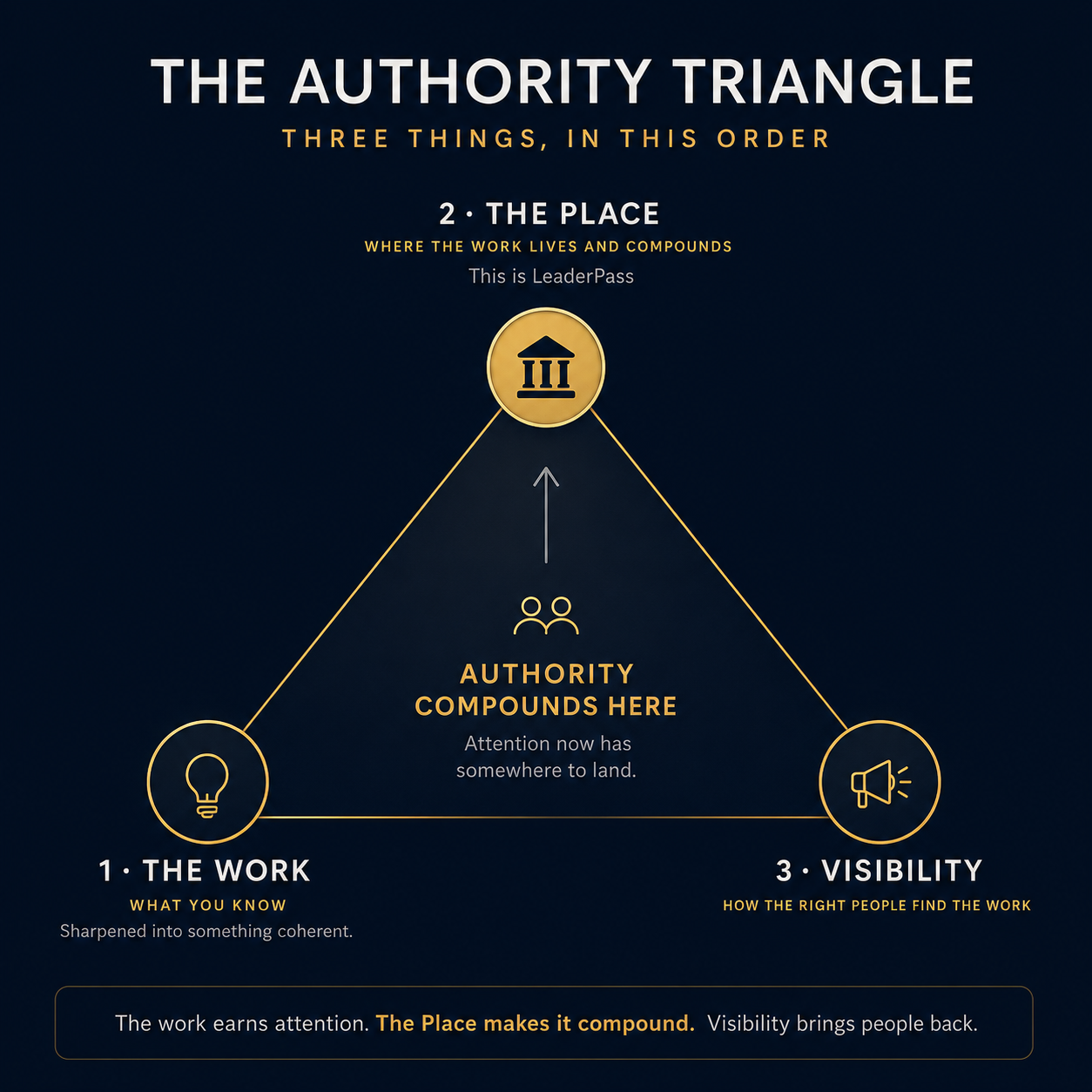
    Third, it receives visibility. When an expert speaks on a stage or appears on a podcast or posts on LinkedIn, the audience that follows them somewhere has to land somewhere. If that destination is a course page, the audience has to be ready to buy that exact product right now or they leave. If it is a collections page, they can sample the thinking, explore the body of work, and decide whether this is someone worth following. The Authority Triangle holds the line: visibility creates the opportunity, the Place captures the value. That capturing requires an environment built to do it.

    Running both tools

    LeaderPass is more than a platform. It is three things working as one: the way the work gets shaped, the way it gets made, and the branded place where it lives. That integration includes the transaction layer. Individuals can purchase access directly. Teams can purchase access. Organizations can purchase access. Payment processes through the expert’s own Stripe account, and the person who buys gets a receipt and account access immediately.

    What LeaderPass does not do natively is drip email and marketing automation sequences. If an expert has a MailChimp or HubSpot workflow built around their launches, that stays in place. LeaderPass integrates with both. The automation layer the expert already uses keeps working. What changes is where the audience lands when that automation has done its job.

    Some experts will keep Kajabi for specific delivery configurations they have built over time. Others will find they no longer need it. That depends on the setup. The point is not that both tools are always necessary. The point is that LeaderPass is the destination environment, and the course-delivery question gets answered inside that architecture, not the other way around.

    How a Place compounds over time is a separate question from how a course converts. Conversion is transactional. Compounding is structural. A course platform is built for the first. The Place is built for the second.

    The question most people are actually asking

    The search that brings someone to this piece usually comes from a specific frustration. The course is live. Kajabi is working. But there is no sense that the expert’s presence is building into something. Every launch cycle resets. Every new piece of visibility has to be earned fresh. The audience does not seem to be accumulating in any meaningful way.

    That is a destination problem, not a Kajabi problem. Kajabi is doing exactly what it is designed to do. The issue is that completion-oriented delivery is not the same as a body of work that compounds. The expert has a product. They do not yet have a Place.

    A course platform delivers what you give it. A Place is the destination the work lives in.

    Most experts arrive at this realization when they realize that what they want is not better features on their course platform. What they want is for the work to keep working. For the thinking they have done over years to exist somewhere that an audience can find, explore, trust, and return to. For the attention they are generating to land somewhere durable.

    Kajabi cannot do that job. Not because Kajabi is weak. Because that is not what Kajabi is for.

    You may not need to replace Kajabi. You need to stop treating Kajabi as the whole environment.

    The Place is built to hold the whole body of work. The course-delivery layer sits inside it. When that architecture is in place, attention compounds. The audience accumulates. The work keeps working long after the launch ends.

    Questions worth answering

    Should I cancel my Kajabi subscription if I get a LeaderPass?

    Probably not immediately, but it depends on your setup. Kajabi handles drip sequencing and email automation natively, and if you have workflows built around those functions, those stay in place through integrations. Some experts keep Kajabi for specific delivery configurations they have spent time building. Others find they no longer need it once LeaderPass is handling the full body of work, including transactions. The honest answer is: it depends on what you have built and what you still need.

    Can Kajabi be my Place if I customize it heavily enough?

    The distinction is architectural, not cosmetic. A heavily customized Kajabi environment is still organized around products, still built around completion, still designed to deliver what you upload rather than to hold a body of work that people return to. Design quality does not change the underlying logic of the system. What the platform was built to do is not changed by how it looks.

    Is LeaderPass cheaper than Kajabi?

    LeaderPass is not priced as a Kajabi alternative because it is not a Kajabi alternative. The pricing reflects the integrated system — Blueprint, Studio, Place — rather than a tool-only subscription. Comparing the two on price is comparing a course platform to a system that shapes, produces, and houses the body of work. Different scope, different model.

    Can I migrate my Kajabi courses to LeaderPass?

    LeaderPass handles the full transaction: individuals, teams, and organizations can all purchase access, payment processes through your Stripe account, and buyers get immediate account access with no delay. Courses live inside the Place as part of the full body of work, alongside frameworks, recordings, and whatever else belongs there. Whether you keep Kajabi depends on what your current configuration requires — some experts do, many don’t.

    Why are there so many course platforms but only one Place?

    Course platforms solve a known job: deliver paid educational content. Many vendors have built tools for that job because the requirements are understood and the model is proven. The Place is a different architectural layer. Building it requires integrating the way work gets shaped, the way it gets made, and the environment that holds it, under one system. Few have attempted that because it sits between categories that rarely live inside one company. That is the gap LeaderPass was built to fill.

  • The pop-up trap

    I have watched a lot of experts launch what they thought was a business.

    The webinar converted. The cohort filled. The launch sequence hit the number. Emails went out. Screenshots went up. Everyone congratulated them.

    Then the second cohort came around six months later, and the numbers were different. Then the third. By the fourth, they were calling it a slump. Blaming the algorithm. Planning a relaunch with new positioning and different creative.

    None of those were what was happening.

    They had built a pop-up. They had proven demand. They had not proven a business.

    What the playbook actually measures

    The internet marketing playbook teaches experts to validate before they invest. Run a webinar. Fill a beta cohort. Prove someone will pay before you build something permanent. For some kinds of products, this works fine. For expertise, the problem is what the playbook is actually measuring.

    When a webinar converts, you have measured whether this particular person will buy this particular offer, one time, in this particular window of attention. That is a real signal. It is not, however, the signal most experts think they collected.

    They think they collected: people want this. What they actually collected: people bought this. Once.

    Those are different things. One of them is a business. The other is an event.

    The misdiagnosis

    When a second cohort underperforms, most experts run the same diagnosis. The creative was stale. The market shifted. The email list got cold. The ad targeting drifted. The energy of the beta moment couldn’t be recreated. So they try to recreate the conditions of the first launch: new angles, new hooks, new energy, same offer, same cycle.

    This is the wrong diagnosis. The creative didn’t fail. The model failed. What they built was a pop-up, not a Place, and the correct response to a pop-up slumping is not a better pop-up.

    There is a specific compounding error worth naming inside the misdiagnosis. When the second cohort slumps, a lot of experts do not cut their ad spend. They increase it. The logic is: the first cohort filled, so more visibility should fill the second. And then the third. This is how a launch-cycle problem becomes an expensive launch-cycle problem.

    Visibility is not bad. Visibility is just expensive when there is nothing built to receive it. Running more campaigns at a pop-up architecture doesn’t fix the architecture. It brings more people to a Place that isn’t there.

    Three versions of the same pattern

    I will give three observational sketches, because the trap shows up in different costumes.

    The first version: the expert whose first cohort filled and slumped. They spend the next eighteen months trying to recreate the energy of that first launch. New angles. New offers. New ad creative. Nothing works the way the first one did. What they never notice is that between February and July, nothing existed for the audience to come back to. The launches kept filling at a worse rate. The Place was never built.

    The second version: the expert who “goes premium” after three filling cohorts at $1,500. The first $5,000 cohort fills. The next sits at half capacity. They conclude the market won’t bear the higher price. The price wasn’t the variable. They still built a pop-up. Raising the price just slowed how long it took to find out.

    The third version: the expert on their fifth annual launch cycle. Each one works, barely. They are exhausted. They cannot stop launching, because the moment the launches stop, the business stops existing. There is nothing else.

    The pattern is the same in all three. The effort produces purchases. Nothing exists between them.

    What the pop-up actually proves

    Here is the kindest framing I can offer for why so many experts end up here: the system told them it worked. The metrics said yes. The money came in. The launch felt like a launch. Every signal available to them said they had built something real.

    The signal they didn’t have was return behavior.

    A business exists between purchases. People know where to find it. They come back to it under their own power. They refer other people to it because it still exists when they do. A pop-up doesn’t do any of those things. It exists while you’re selling it, and then it goes dark.

    There is a version of this in the physical world that makes the problem immediately obvious. Imagine a chef who refuses to open a restaurant until they have proven demand. They run pop-up dinners. The pop-ups sell out. They make money at every event. After a year of this, what they have built is a track record of selling food at events. What they have not built is a restaurant. Meanwhile, every chef who actually opened a restaurant that year has regulars, reviews, neighborhood reputation, repeat visits, a brand that exists whether they are cooking that night or not.

    The pop-up chef isn’t doing something wrong, exactly. The events are real. The cooking is real. The demand is real. What’s missing is the Place. And without the Place, the demand stays at the event. Someone liked that dinner. They don’t know where you are now.

    Most experts are advertising a restaurant they haven’t built yet. The pop-up trap is a particular version of that pattern, and it has a specific cruelty to it. The pop-up chef at least knows they are running events. The expert who filled their first cohort often genuinely believes they opened the restaurant.

    The correction

    The experts I have watched navigate out of the pop-up trap do not stop running launches. They stop treating the launch as the business.

    The launch becomes the front door. The Place is what people walk into when the door opens. Once a Place exists, the launch has somewhere to send people. The audience that converts doesn’t disappear between campaigns. It accumulates.

    This is the mechanism behind how a Place compounds over time. Not more launches. A Place that keeps working after the launch ends. That is what return behavior requires. Not a better funnel, but somewhere durable for the audience to go. (The order matters: a Place before more visibility, every time.)

    A Place where expert work lives does not mean an elaborate build. It means an environment that exists independently of your selling. That people can find on their own terms. Where your work stays organized in a form that still works when they come back to it six months after the cohort closed.

    A webinar can prove someone will buy. It cannot prove they will come back.

    Those are very different things. The first is easier to build. The second is the one worth building.

    I would rather you build the Place slowly than build a pop-up well.

    — Jamie

  • How a Place Compounds Over Time

    Most online content does not compound. A post peaks within forty-eight hours of going up and decays from there. Courses get consumed once and end at the completion screen. A viral keynote moment circulates for a week, then gets buried under whatever the platform shows next. The expert produces more content to make up for the decay, and the decay never stops. A Place compounds because the architecture is built for something else entirely. People return to it. They return for different reasons at different times. They bring others. The work gets more useful as the audience around it grows older and the body of work gets larger.

    The architecture is what produces that result.

    Why most work doesn’t compound

    The default online environment is built for acquisition. Everything downstream of that initial moment of contact is somebody else’s problem. A social platform is designed to send attention somewhere else and then send it somewhere else again. A course platform organizes content so the user can get to the end and finish. A website is built to convert this visit, on this visit. None of these architectures has any structural interest in whether anyone comes back.

    Most experts have a landing problem, not a visibility problem. They generate attention from a keynote, a podcast appearance, or a well-timed post, and the attention has nowhere to go that keeps working. The audience arrives, looks around, and leaves. Very little about the architecture is designed to bring them back.

    The result is that the expert’s work does not accumulate in any meaningful sense. They have posts without an underlying position. They have sales without a body of authority that predates this month’s launch. Every piece of content they produce is essentially starting from zero, because the environment it lives in is not built to remember anything.

    The work is good. The architecture fails it.

    What compounding actually requires

    The Place is the environment where an expert’s body of work lives so people can return to it, trust it, and use it over time. That definition has one clause worth pausing on: over time. The piece is not describing what happens at launch or inside a thirty-day window. It is describing what happens across years.

    Compounding, in this context, means the work becomes more valuable as time passes rather than less. Return visits add context that the first visit could not produce. New pieces strengthen the older work they sit next to, and the audience that shares the Place with someone else does so because the work was still worth sharing months after they first encountered it. A Place should be useful six months later.

    Most environments cannot produce this. The architecture gets in the way. Understanding why compounding happens in a Place requires looking at three specific mechanisms: return-orientation, hierarchy, and the environment carrying the work.

    Mechanism one: return-orientation

    A platform built for completion organizes content so it can be consumed in a straight line. The user starts, moves through, finishes, and leaves. The platform’s job ends when the user clicks done.

    A Place is built for the opposite outcome. The success question is about return. Did they come back when the work mattered again? Three weeks after someone encountered a leadership framework inside a Place, they do not want to start over from the beginning. They want the specific piece that applies to the conversation they are about to have. The architecture is built to make that retrieval possible.

    This changes what the expert’s work does over time. Content built for completion has a single valuable moment: the first time someone moves through it. When the same content sits inside a return-oriented environment, it produces value every time a real-world need sends someone back into it. The same piece of work generates usefulness repeatedly, without the expert doing anything additional. That is the first layer of compounding.

    Visibility that does not lead to a Place leaks. The expert earned the attention, but the environment around them was not built to receive it. Return-orientation is what makes receiving possible.

    Mechanism two: hierarchy

    Most experts have accumulated work over years. A keynote here, a course there, a workshop replay, a downloadable framework. On a typical platform, those exist as a list of products: six tiles on a dashboard, a folder of files, a content library. The audience sees inventory. They do not see a body of work.

    Inside a Place, that same work becomes a body. The audience sees what to start with, what builds on what, what to come back to, what was foundational, what was advanced. The expert is no longer a person with multiple products. The expert is a person with one coherent body of authority that has multiple ways in.

    The difference between a shelf and a library is hierarchy.

    Hierarchy produces compounding in a specific way. When a new piece of work is added to a library, it does not just add itself. It adds context to everything around it. The existing pieces become easier to navigate, and the body of work becomes more coherent. A new piece that sits alongside a related piece from two years ago retroactively gives that older piece more authority, because now the audience can see the through-line.

    On a platform without hierarchy, a new piece competes with old ones for attention. The feed fills with the newest content, and everything behind it fades. The architecture forces the work to compete with itself.

    Inside a Place, the order of the Work, the Place, and Visibility matters because hierarchy is how the Place keeps the Work coherent as the body of it grows. New work and old work reinforce each other. The architecture lets the work add up.

    Mechanism three: the environment carries the work

    The environment a viewer encounters work in determines how seriously they take it. The judgment is made before any idea has been heard. This is a structural fact about how the audience perceives authority online, and it is the third source of compounding.

    A serious body of work placed in a generic dashboard feels like another online course. The work did not change. The environment failed it. A Place tells the visitor what kind of work they are encountering before they press play. The credibility judgment is made on arrival.

    Over time, this compounds. An expert who has had a Place for two years has an environment that has been building credibility with every visit. The audience that returns does not re-evaluate the expert from scratch each time. They return to a context they already trust. That accumulated trust is not something the expert has to rebuild with each new piece. The environment keeps doing that work.

    This is why a Place functions as more than a container for content. A container is passive storage. An environment is active in a way that compounds: every interaction inside it contributes to the credibility judgment the next visitor will make.

    Without that environment, every new piece of visibility is advertising a restaurant the expert has not built yet. The visibility resets the clock instead of extending it.

    The year-five observation

    Consider two experts at year five. They have produced roughly the same volume of content over those five years. The ideas are of similar quality. Their general presence in the category is roughly equivalent. One has had a Place for those five years. The other has the same work scattered across platforms.

    On paper, they look identical.

    They are not the same business.

    The expert with a Place has five years of return behavior built into the architecture. Audiences who first encountered the work in year two have come back multiple times. Early pieces have accumulated relevance through the work built around them. The environment has been doing compounding work for five years, without the expert producing more to compensate.

    The expert without a Place has been operating on a different model. Activity, output, and repeated visibility purchases keep the work alive in the present. The work is real and the authority is real, but the architecture is not doing additional work over time. Everything still depends on the expert producing more right now.

    The difference is structural rather than qualitative. A Place is what makes a body of work compound. Without it, the work decays at the speed of the platform it sits on.

    LeaderPass is the Place where your work lives and keeps working — long after the moment ends.

    FAQ

    How long does it take a Place to start compounding?

    The architecture compounds from the first month. Return behavior is possible from the moment the Place exists and the first audience encounters it. What takes longer is the point at which compounding becomes a measurable business input. That typically becomes visible between months six and twelve, when returning audience is large enough to show up in patterns: people who share the Place with others, people who come back without being prompted, people who reference older pieces in conversations with the expert. The compounding was happening before that. It simply wasn’t visible yet.

    Does this apply if I’m constantly producing new content anyway?

    New content produced into a non-compounding environment does not compound. The volume does not change the architecture. A high-output expert on a platform built for completion is generating more content that peaks and decays faster than it did before. The volume produces more content. It does not produce more compounding. The Place is what makes the new content compound retroactively, by housing it alongside prior work in an environment built for return. The expert does not have to produce less. What has to change is the environment the work lives in.

    What if my Place stops getting visited?

    A Place still requires upkeep. Periodic additions, occasional refreshing of entry points, making sure the Work remains accessible as the body of it grows. But the compounding mechanism is structural. It is not dependent on constant activity to keep producing value. A Place with one new piece per quarter still compounds, because the architecture is doing the work. A blog with five posts per week has nothing producing additive value over time, regardless of cadence. A Place that goes quiet for a few months does not lose the compounding it has built. A high-volume platform that goes quiet for a few months loses the visibility that was keeping it alive.

    Is compounding the same as evergreen content?

    Evergreen content is content that stays relevant over time. Compounding is structural. The architecture itself produces additive value as time passes, independent of any single piece. Evergreen content inside a non-compounding environment still decays relative to newer content, because the platform architecture buries it. Evergreen content inside a Place compounds, because the environment is built to make return to older work possible, and the hierarchy makes older work findable alongside newer work. The Place is the structure that makes evergreen content behave the way the term implies.

  • What kind of expert needs a Place?

    A Place is for experts whose business depends on people returning to their work over time. Speakers, authors, coaches, consultants, subject-matter experts, organizations building around a body of expertise. The practical test is this: if someone you respected asked tonight where to find the best of your thinking — not your bio, not your offer, but your actual work — where would you send them? If you would not have one clean answer, and your business depends on people trusting your thinking enough to engage past a single moment, you are the kind of expert who needs a Place.

    If your business runs entirely on transactional sales, one-time launches, or a single product that completes when bought, you may not.

    That distinction is worth being honest about, because a Place is a specific kind of investment. It is not the right one for every expert at every stage.

    What the Place is for

    The Place is the environment where an expert’s body of work lives so people can return to it, trust it, and use it over time. Not a website, which tells people what you do. Not a course, which delivers what someone bought. Not a community, which holds conversations. Those tools do their jobs. The Place is the destination those tools were never built to create — the environment where the work actually lives and keeps working.

    Most experts do not have one. They have several things scattered across several platforms, and when someone wants to go deeper, there is nowhere durable to send them. That is not a visibility problem. It is a destination problem.

    A Place solves for that. But only for the expert who has a business shaped the right way to need it.

    Speakers

    A speaker whose business lives and dies at the stage may not need a Place yet. Someone who books keynotes, delivers them, and fills the next calendar from those engagements has a business built on performance. The Place becomes relevant when the goal shifts.

    If inbound attention is supposed to follow the stage — if the keynote is supposed to create trust that compounds into something else — then there has to be somewhere for that trust to land. Most speakers send the audience to a website or a course they bought at the back of the room. Neither holds the work in a way that earns a return visit six months later.

    The speaker who needs a Place is the one for whom the keynote is not the product. The thinking behind the keynote is the product, and the stage is the visibility channel that is supposed to lead people to it.

    Authors

    A book is not a Place. Neither is the publisher’s landing page, the Amazon listing, or the author’s website. A book is a fixed object that delivers what is inside it once. For most authors, that is the entire architecture: write the book, build the launch, move to the next one.

    The author who needs a Place is the one for whom the book is a credential, not the full body of work. Typically this matters most in the eighteen months following a launch, when the book is still actively doing work — when it is being assigned in courses, cited in podcasts, recommended by people who heard about it — and the author has nowhere to send the audience that wants more than the book itself.

    A book published without a destination for the audience it creates is a door that opens to a hallway with no rooms.

    Coaches

    The coaching business is the clearest case for a Place. A coach’s work is inherently return-oriented — the value is not delivered in a single session. It builds across engagements, across cohorts, across the years someone has been applying the thinking.

    The problem is that most coaches’ bodies of work do not live anywhere. The frameworks exist inside sessions. The frameworks exist in documents clients may or may not have kept. If a former client wants to go back to something foundational, or a new prospect wants to understand the body of thinking before buying a program, there is often no destination to send them to.

    A Place gives the work an address. Not a sales page. Not a description of the methodology. The actual work, organized in a way people can enter, use, and return to when it matters again.

    Consultants

    Consultants whose business is built on recurring engagements have the same structural issue as coaches, with different vocabulary. The work exists in decks, in reports, in workshops that have already run. The body of thinking behind all of it rarely lives anywhere accessible.

    For the consultant whose next engagement depends on a prospective client understanding the depth of the approach — not just reading a case study, but genuinely experiencing what the work is — a Place is the difference between being considered and being trusted before the conversation begins.

    Organizations

    The audience qualification for organizations is almost identical to the audience qualification for individual experts, with one difference: the audience is internal rather than external, or both.

    An organization building around a body of expertise — internal training, institutional knowledge, a leadership framework developed over years — has the same destination problem. The work gets created, delivered, and then lost. New staff cannot access what the last cohort learned. The framework is described in a document that gets forwarded and then forgotten.

    A Place gives that knowledge somewhere to live so the organization can actually use it. The test for an organization is the same as the test for a speaker: if someone who needed the core of what you know tried to find it tonight, would they have one clean answer for where to go?

    Who the Place is not for yet

    Some readers should leave this piece concluding not yet. That is the right conclusion for them.

    If the business is a single high-converting product and the funnel runs cleanly, a Place is a later-stage investment. The architecture is not wrong; the timing is. Build the product, prove the conversion, then ask what has to exist for the business to compound rather than repeat.

    If the work is early — if the body of thinking has not been articulated, the audience has not been built, and the expertise is still being developed through practice — a Place needs work to live in. The Place starts before the upload, but not before the thinking. Build the work first.

    The honest version of this is not disqualifying. It is clarifying. A Place is one tool in the architecture of an expert business. It is not the only tool. It is not always the first tool. It is the right tool for the expert who has real work, a business built on people returning to that work, and currently no single destination worth sending them to.

    The practical test

    Set the question in front of yourself plainly.

    If someone you respected asked tonight where to find the best of your thinking — not your bio, not your offer, but your actual work — where would you send them?

    If you had to list three or four things, or hedge with it depends on what they are looking for, the work does not have a home. That is what a Place solves for. Not the quality of the work. Not the depth of the expertise. The fact that the work needs somewhere to live that holds it properly.

    A Place should be useful six months later. The question is whether the destination exists yet to support that.

    For the expert who recognizes themselves in this — the one whose business depends on return, and who does not yet have a destination worth returning to — the next question is not whether to build a Place. It is what the work would have to become to be worth being returned to.

    That is the architectural question underneath this one. The kind of expert who needs a Place is the kind whose work is supposed to be returned to. LeaderPass is the Place because the expert can finally point to it. And mean it.

    Frequently asked questions

    I am a speaker. Do I need a Place?

    Probably, if inbound trust is supposed to follow the stage. If someone hears you at a conference and wants to go deeper, where do you send them? If the answer is a website, a course they have to buy immediately, or a few links that go different places, the stage is generating attention that has nowhere to land. A Place gives that attention a destination.

    I am an author with a recent book. Do I need a Place?

    Yes, particularly in the period when the book is actively creating interest. A book delivers what is inside it; it does not hold the audience that wants more than the book. If the book is doing its job as a credential or a conversation-starter, and there is no destination for the reader who wants to go further, the work you put into the book is generating trust you cannot capture.

    I run an organization that develops internal training. Do we need a Place?

    Yes, though the vocabulary shifts. The question for an organization is whether the expertise you develop internally actually lives somewhere, or whether it gets delivered and then lost. New staff cannot inherit what previous cohorts learned. The work gets rebuilt from scratch. A Place gives institutional knowledge an address — somewhere the organization can send people when the work matters, not just when a program is running.

    I run a single course that converts at a high rate already. Do I need a Place?

    Maybe not yet. If the single course is the entire business and the funnel is working, a Place is a later investment. The architecture will eventually matter — once the business needs to compound rather than repeat, and once the expert wants to build something that holds work across multiple programs, formats, and years — but rushing it before the foundation is solid is not the right order.

    I am newer and do not have much published work yet. Should I build a Place now or wait?

    Build the work first. A Place needs work to live in. The environment is only as strong as what it holds, and building the container before the content is ready is one of the more common ways experts stall at the architecture level without realizing the work itself was the gap. Develop the thinking, test it in front of audiences, build real material. Then ask whether it needs a home. At that point, the answer will be obvious.

    Related: What is the Place where expert work lives? | What is the Authority Triangle? | Most experts are advertising a restaurant they haven’t built yet

  • Why a website isn’t a Place

    A website tells people who you are. A Place is where they go to experience the work. The two get treated as the same thing, and that confusion is what produces flat traffic, weak conversion, and the recurring sense that the website “needs a refresh.”

    A website is a brochure. It tells a visitor who you are, what you do, and how to reach you. The brochure is useful. The brochure is also not a destination. A website introduces. A Place is where the introducing leads. Most experts ask the website to do both jobs, which is why it keeps feeling like it needs a refresh. It is being asked to do work no website was built to do.

    The Place is the environment where an expert’s body of work lives so people can return to it, trust it, and use it over time. A website rarely meets that description, and it was never supposed to.

    What a website is for, and what a Place is for

    A website does three things well. It introduces you, it points people toward what you offer, and it announces what is current. Someone arrives, reads the bio, sees the offer, gets the contact details, and leaves. The visit is short by design. Once the introduction is made, the website’s job is mostly finished.

    A Place does a different job. People arrive, and instead of reading about the work, they enter it. They sample the thinking before being asked for anything. They come back three weeks later for the part that applies to the conversation they are about to have. They return six months later because the work is still useful. A Place should be useful six months later. A website rarely is, because a brochure is not built to be returned to.

    This is why the same body of work can feel completely different depending on where it lives. Behind a standard website, a serious framework reads as a service description. Inside a Place, the same framework reads as a body of work someone built deliberately. Nothing about the thinking changed. The environment around it did.

    This is the same architectural distinction that separates a Place from a course platform and from a community. A course delivers something a person bought. A community is a conversation space. A website introduces. Each of those is a real job. None of them is the destination the others are supposed to point to.

    The refresh loop

    Here is the pattern I have watched play out for years. An expert has a website. Traffic is fine, but it does not convert the way it should. The diagnosis is almost always the same: the website needs a refresh. So they rebuild it. New design, new copy, new photography. For a few months it feels better. Then the same flatness returns, and the conversation about another refresh starts again.

    The refresh rarely fixes it because the refresh is aimed at the wrong problem. The website is not underperforming because it looks dated. It is underperforming because it is being asked to be a destination, and a brochure cannot be a destination no matter how well it is designed. Most experts have a landing problem, not a visibility problem. The same logic applies to the website. The design is usually fine. What is missing is a destination behind it.

    When the work has nowhere durable to live, every channel points back to a page that introduces and then stops. The podcast appearance sends people to the website. The keynote sends people to the website. The newsletter sends people to the website. They read the bio, they see the offer, and unless they are ready to buy the exact thing on offer that day, they leave. The attention arrives and then leaves, because there is nothing built to receive it.

    That is the refresh loop. The website is doing exactly what a website does well. It has simply been assigned a second job it was never built for.

    What to do instead

    The fix is not to throw out the website. A website that knows its job is useful. The fix is to stop asking it to be the destination.

    An expert who has a Place has two clean options. The first is to keep the website as the front of house and let the Place be the destination it points to. The website introduces, then routes people to the Place where the actual work lives. The second is to let the Place replace the website entirely and serve as the front door itself. Both work.

    What does not work is the middle position, where the website is asked to introduce and to be the destination at the same time. That is the version that always feels like it needs another refresh. Once the website has a real destination to point to, the pressure on it drops, and it can go back to doing the one thing it is good at.

    A website tells people what an expert does. A Place is where they go to experience it. When a website keeps feeling like it needs a refresh, the missing piece is usually a destination for it to point to. Once that destination exists, the website can go back to being a good brochure.

    Frequently asked questions

    Should I get rid of my website if I have a Place?

    Not necessarily. A website and a Place can coexist, with the website introducing people and the Place serving as the destination it sends them to.

    What should my website do once my Place is where my body of work lives?

    The standard brochure jobs: introduce you, point people toward what you offer, and announce what is current. The difference is that it now has a clear destination to route people to instead of trying to be that destination itself.

    How do I know if my website is doing too much?

    If it feels like it needs a refresh every year or two, and each refresh improves the look without fixing the underlying flatness, the website is probably being asked to be the Place. That recurring dissatisfaction is the signal.

    Can a website be designed to be a Place?

    Architecturally, yes. But what you would be building at that point is a Place that happens to serve as the front door. Calling it a website undersells what it is doing. If you want the fuller picture of what a Place actually is, that is covered separately.

  • What’s the difference between a community and a Place?

    A community is a conversation space. A Place is the destination where an expert’s body of work lives. The community is the room where the people who care about the expert’s work talk to each other. The Place is where the work itself is housed. They sit next to each other and do different jobs. Many experts have both. Some have only one. The mistake most experts make is collapsing the two into the same thing.

    Once that distinction is named, the rest of the architecture follows.

    What a community actually is

    A community is built around the members. The product is the room and the interactions inside it. Threads, channels, posts, comments, replies, live calls, peer-to-peer connection. The expert may show up, may host, may seed conversation, may run cohorts inside it. But the center of gravity is the membership talking to each other. Take away the conversations and there is nothing left to return to.

    That is what a community does well. People in similar situations find each other, exchange notes, build relationships, and stay accountable. The audience-to-audience layer creates value the expert could not produce alone. A good community runs on engagement. It is supposed to be busy. Quiet rooms are failing rooms.

    That is real work. It is not the same work as building a Place.

    What a Place actually is

    The Place is the environment where an expert’s body of work lives so people can return to it, trust it, and use it over time.

    The audience experiences the expert through the body of work, not through the conversations about the body of work. Inside a Place, the expert’s thinking is the artifact. The keynote, the framework, the methodology, the deeper teaching, the references that connect them, the architecture that tells someone what to start with and what builds on what.

    A Place runs on return. Not engagement. Not completion. Return. Someone walks back in eight months later because they remember a specific idea that applies to a problem they are facing right now, and they need to find it again, take it seriously, and use it. The Place is built for that moment.

    A community holds conversations. A Place holds the work.

    This is the cleanest way to describe the architectural difference.

    A community is where the audience finds each other. A Place is where the audience finds the work. Two different relationships, two different jobs, two different success metrics. The community succeeds when members are talking. The Place succeeds when the body of work is being returned to. Both can be true at once. Neither requires the other to function.

    Where the collapse happens

    Most experts who confuse the two have built a community first, called it their Place, and then watched their actual body of work scatter across the conversations inside it.

    The keynote sits in a feed somewhere. The framework lives in a pinned post that gets lost the next time three people ask a question. The original teaching is buried under six months of replies. The work is technically there, but it is not in an environment that lets anyone return to it cleanly, and it is not in a form the audience encounters as a body. They encounter it as fragments scattered through a conversation that has moved on.

    The community is doing its job. The Place is doing no job, because there is no Place. The expert mistook the room for the architecture.

    The reverse also happens. Some experts build a Place first and then bolt on a community feature because the platform offered one, and treat the feature as if it were equivalent to a real community. It rarely works. Communities run on continuous interaction, careful moderation, and a center of gravity the expert cannot produce part-time. A community as a feature is usually a community as a placeholder.

    Why this matters for the Authority Triangle

    The Authority Triangle runs on three things in order: the Work, the Place, and Visibility. The Place sits between the Work and Visibility for a structural reason. Visibility brings attention to the Place. The Place is what the attention arrives inside of. When the attention arrives inside a conversation feed instead of inside a structured body of work, the visibility produces engagement but not authority. People talked. Nobody returned to the work itself, because the work itself was not the center of the experience.

    A community can amplify a Place. It cannot stand in for one. The order matters: build the work, create the Place, then drive visibility into the Place. The community sits alongside that sequence, doing its own job for its own reasons.

    When you want both

    Some experts genuinely need both. A cohort-based program with strong peer dynamics needs a conversation space. A leadership development engagement that runs across many people inside an organization may need both a structured body of work people can return to and a room where they discuss what they are encountering.

    In those cases, the architecture is clear. The Place is the destination. The community is the space alongside it. The body of work is housed in the Place. The conversations about the body of work happen in the community. Neither tries to be the other. The expert is not trying to make their community look like a Place or trying to make their Place behave like a community. Each does its own job, and the audience knows where to go for what.

    When you want only one

    Many experts do not need a community at all. The work compounds inside a strong Place. People return. They reference. They use it. They do not need to be talking to each other for the expert’s authority to build, and the expert does not need the operational burden of running a conversation space they cannot give serious attention to.

    Other experts genuinely run their practice on the community. The peer-to-peer layer is the value. The expert’s job is to facilitate, not to author a body of work people will return to over years. That is a real model. It is also not a Place.

    The diagnostic question is simple. A Place should be useful six months later. If the answer to “where does someone find the best of your thinking six months from now” is a conversation thread, the answer is incomplete. If the answer is “in the room where members are talking,” the room is doing the community’s job, not the Place’s.

    Course platforms run into the same collapse from the other direction.

    LeaderPass is the Place because the expert can finally point to it. And mean it.

    Related questions

    Can I use my community as my Place?

    No. A community holds conversations about the work. A Place holds the work itself. Even a strong community leaves the body of work scattered across threads that move on. The audience cannot return to the work cleanly, because the work is not the center of the room, the conversation is. Architecturally, they are doing different jobs.

    Do I need a community if I have a Place?

    No. Many experts have a Place and no community, and the work still compounds. Communities serve specific functions: cohort dynamics, mentor relationships, audience-to-audience connection. The Place does not need to replicate those functions to do its own job, which is to house the body of work in an environment people return to.

    Does the Place have community features?

    Not in the way a community platform does, and that is by design. The Place is built around the expert’s body of work, not around peer-to-peer interaction. Some Places integrate light community features. Most do not, and the expert is no worse off. The center of gravity is the work.

    What about hybrid platforms that combine community and content?

    Hybrid platforms do both jobs adequately. The architectural question stays the same. Which job is the destination, and which is a feature inside the destination? When the conversation is the destination and the work is a feature inside it, the expert has a community. When the body of work is the destination and the conversation is a feature inside it, the expert has a Place.

Privacy Preference Center