YouTube is visibility. LeaderPass is credibility. They are not competitors. They are two layers of the same stack, doing two different jobs, and most experts treat them as if they were the same thing. So the channel grows. The audience gets larger, the watch time goes up, and the business underneath it stays close to where it started. That gap is not a YouTube problem. It is a layer problem, and no number of additional uploads will close it.
What YouTube is built to do
Start with what YouTube does, because it does it well. YouTube finds people. It puts an expert’s work in front of an audience that would never have searched for them by name, and it does this at a scale almost nothing else matches. For the visibility job, it is one of the most effective tools an expert can use. The mistake is not using YouTube. The mistake is asking YouTube to do a second job it was never built for.
YouTube does its job exactly the way it was built to. YouTube’s job is to keep your audience on YouTube, not with you. The recommendation system exists to hold a viewer’s attention inside the app for as long as possible, which means that when someone finishes one of your videos, the next thing served is whatever keeps them watching. Often that is another creator working in the same subject. The viewer arrived interested in your topic, and YouTube uses that interest to route them onward. You produced the attention. The platform kept the asset.
Here is the part most experts miss: the expert is not building a relationship with the viewer; YouTube is. The subscriber belongs to the platform’s relationship with that person, not to yours. You can be the reason someone opened the app today without being the reason they are still there twenty minutes from now. YouTube keeps your audience. You don’t.
The doorway, not the ecosystem
This is the distinction the comparison usually misses. YouTube is not the ecosystem — it is the doorway. A doorway matters. People have to come through it to reach you. But a doorway is not a place to live, and an expert who treats the doorway as the destination ends up with a great deal of foot traffic and nowhere to put it.
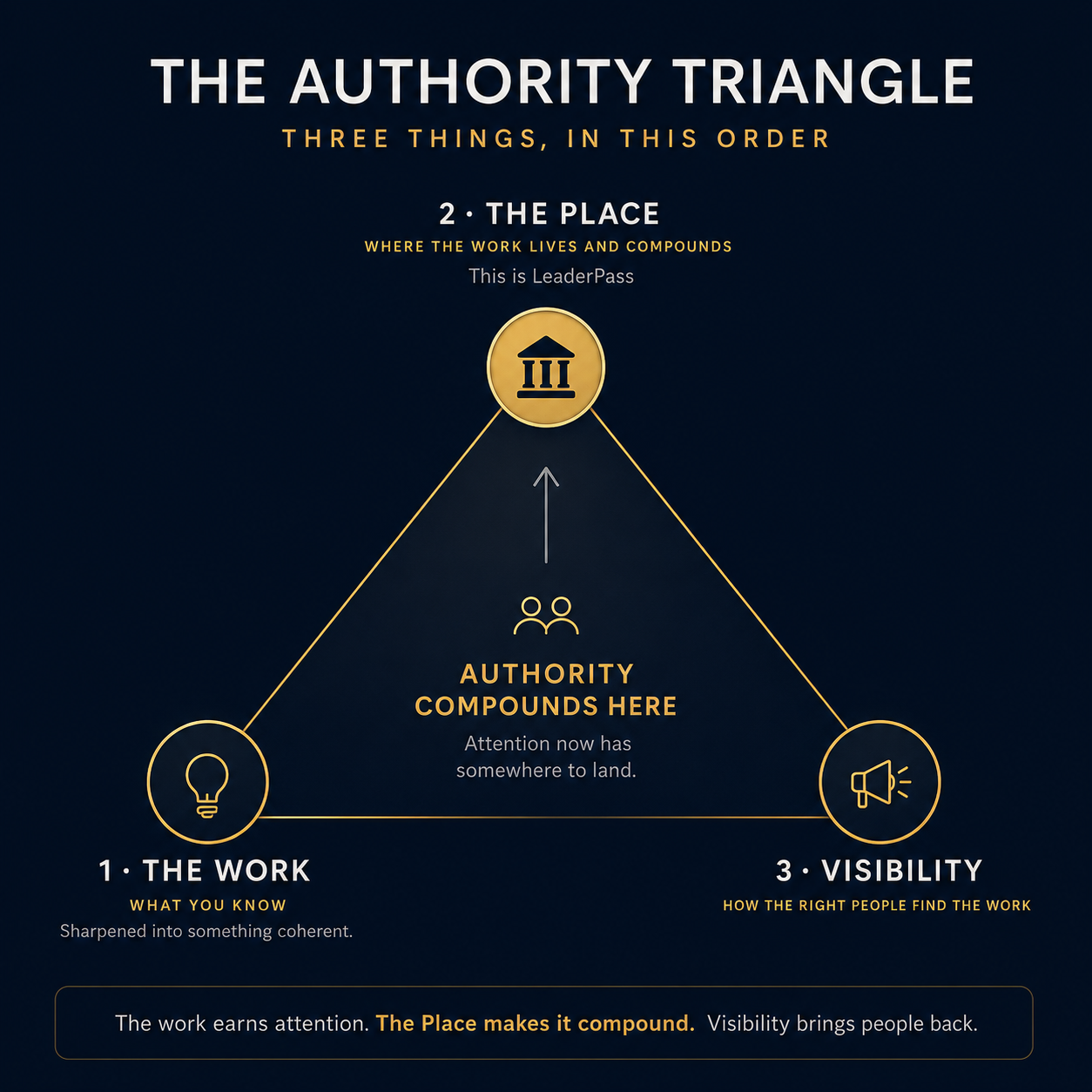
The fuller version of this is the Authority Triangle: the work an expert does, the place that work lives, and the visibility that brings people to it. YouTube sits in the visibility layer, and it is one of the strongest tools in that layer. LeaderPass sits somewhere else entirely. It is the Place where the work lives once someone has decided to look closer. The doorway gets a viewer to the threshold. The Place is what they walk into.
Why more YouTube doesn’t close the gap
When the channel grows and the business does not, the instinct is to make the channel bigger. More videos, better thumbnails, a posting schedule that never breaks. Cadence without a thesis is just noise dressed up as discipline. Sometimes that produces more views. It rarely produces a different result, because the size of the audience was never the problem.
Most experts have a landing problem, not a visibility problem. The attention is already there. What is missing is somewhere for that attention to go that does more than the next autoplay. When a viewer finishes a video and wants more of the thinking behind it, the honest expert frequently has no single answer to give. There is a website, and a course somewhere, and a newsletter, and a few playlists. The viewer absorbs that as a person with things scattered across the internet, and the moment of interest passes. This is the same reason attention leaks when there is no place built to receive it: it shows up faster than there is anywhere to keep it.
What the credibility layer requires
Credibility is not a tone or a coat of polish. It comes from an environment with a few specific properties, and a channel cannot supply them.
The first is ownership. A Place is something the expert owns and controls, so the relationship with the audience belongs to the expert rather than to the platform. The second is return. If your work only lives in a feed, it disappears every day. The work has to be useful again six months later, which means it has to be built to be come back to, not consumed once and scrolled past. The third is a single answer. When someone respected asks where to find the best of an expert’s thinking, the expert should be able to name one destination instead of a list of five. A scattered answer reads as a scattered authority, no matter how strong any single piece is.
There is also the question of how serious the work looks when someone arrives. The same idea placed in a generic feed and placed in an owned environment is received differently, because the environment makes a judgment about the source before a single point is made. On a stage, the room did that job. The lighting, the crowd, and the focused block of time all told the audience this person was worth listening to. Online, the environment has to do the same job. A channel cannot, because it presents every creator the same way. A Place is built to.
The order is the mechanism
The reason the order matters comes down to what each layer can and cannot do. Visibility creates the opportunity. The Place is what turns that opportunity into something durable. Run them in the wrong order and the visibility spend goes to work filling a room that was never built. The expert who builds the work, then the place, then the visibility gets a different outcome from the same effort, because every view now has somewhere to become a relationship instead of a number that resets tomorrow.
A growing channel with no Place behind it produces a familiar pattern. The numbers look like progress. The pipeline does not fill. The expert is widely seen and rarely chosen, because being seen and being trusted are produced by different layers, and only one of them is running.
When YouTube actually is the business
There is a real version of this where YouTube is the business. A creator earning through ad revenue, channel memberships, and brand sponsorships is running a media business, and for that business an audience that lives on YouTube is the entire point. The layer distinction still applies, but the conclusion flips. If the revenue comes from the platform itself, the platform keeping the audience is the model working as intended.
The argument here is for experts whose income comes from their expertise: the speakers, authors, advisors, and operators who sell services, programs, or access to their thinking. For them, a view that never leaves YouTube is a view that never becomes a client. The channel is doing the visibility job. Something else has to do the credibility job, or the channel stays a cost that looks like growth.
Running both layers
YouTube and a Place are not a choice between two options. They are two parts of one working system. A credible expert uses YouTube to be found and uses a Place to be trusted, and the two work together when each one is doing its own job and not the other’s.
YouTube is visibility. LeaderPass is credibility. The expert who runs both layers in the right relationship finally has a channel that compounds, because the attention it produces has a place built to keep it.
Common questions
Should I stop posting on YouTube?
No. YouTube does the visibility job well, and most experts should keep using it. The fix is not less YouTube. It is a Place that catches what the channel produces, so the attention turns into something that lasts past the view.
Can a YouTube channel be the Place?
No. A channel lives on a platform whose goal is to keep viewers on the platform, which means it routes your audience onward the moment your video ends. A Place is an environment you own, built so people come back to your work specifically. Those are different things doing different jobs.
What if my entire business is YouTube monetization?
Then the rules change. A business built on ad revenue, memberships, and sponsorships is a media business, and an audience that lives on YouTube is exactly what that model needs. The layer distinction still applies, but the conclusion is the opposite: the platform keeping your audience is the business working.
This piece is written for experts whose income comes from their expertise rather than from the platform. If you sell services, programs, or access to your thinking, a view that never leaves YouTube is a view that never becomes a client, and the credibility layer has to exist somewhere you own.
Why doesn’t my growing YouTube channel grow my business at the same rate?
Because growth on the channel and growth in the business are produced by different layers. The channel produces attention. The business needs that attention to become trust, and trust is built in a place people return to, not in a feed that moves on. When the channel grows and the business does not, the gap is almost always the missing place, not the size of the audience.
Does this apply to YouTube Shorts too?
Yes, and more so. Shorts produce even more compressed attention with even less room to send someone anywhere. The format is built for the next swipe, not for a decision to go deeper. The mechanism is the same as long-form YouTube, only sharper: more reach, faster, with even less of it becoming a relationship you own.