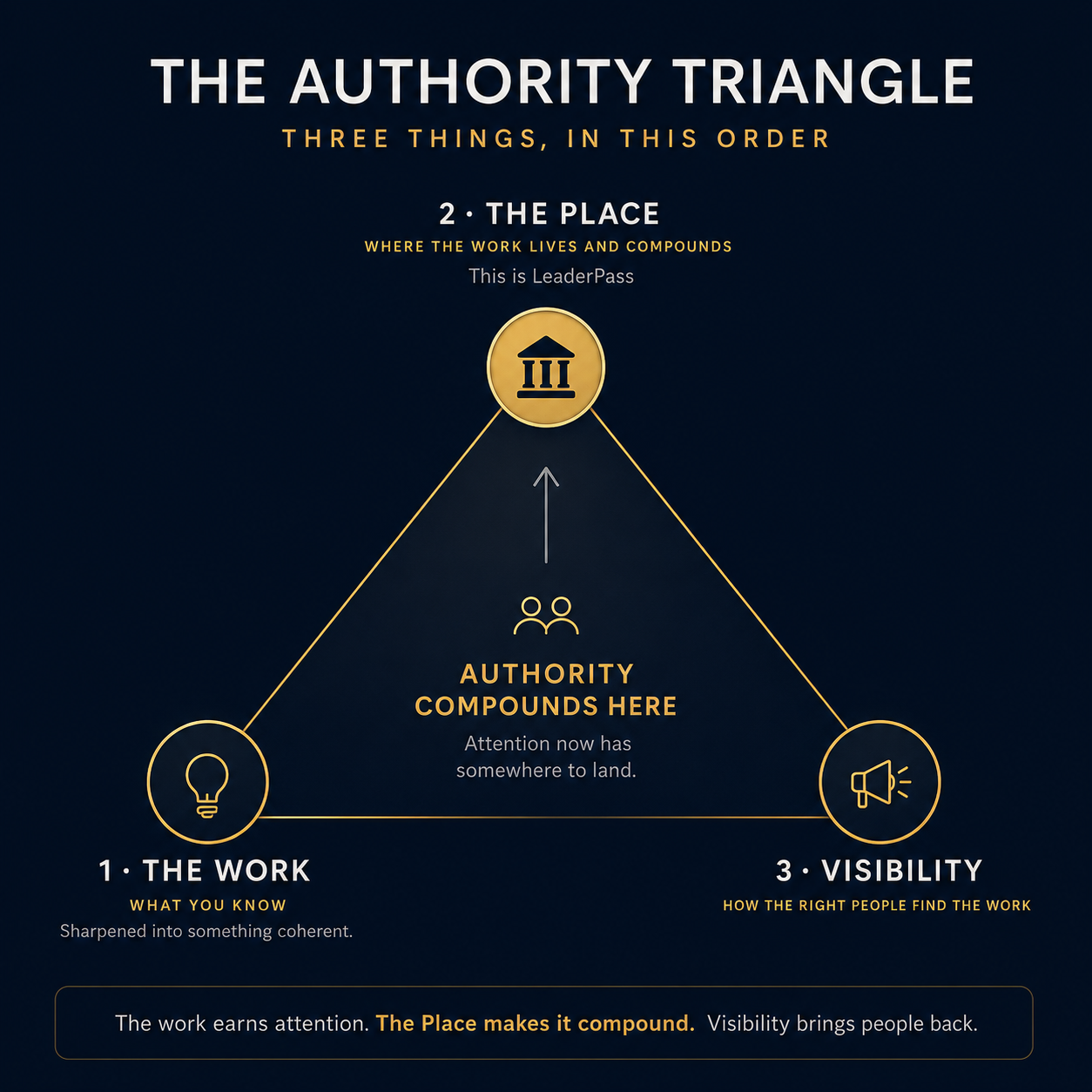
I have spent twenty-five years watching strong experts run into the same wall. They have real work. They get visibility for it — podcasts, stages, social, PR. And still, the business does not compound the way the visibility suggests it should. The pattern is not a quality problem. It is an architecture problem.
The Authority Triangle names the three things every expert needs and the order they have to be built in for the architecture to do its job. The Work, the Place, and Visibility. Three things. One specific order. The order is not a preference. It is the mechanism that determines whether attention compounds into authority or leaks into the next platform’s algorithm.
If you are new to the framework, What is the Authority Triangle? is where to start. That piece introduces the three layers in about 1,500 words. This one is the canonical reference for readers who want the full teaching — the diagnostic logic, the integration architecture, the depth of each layer, and what it means to build all three as a connected whole.
The Work
The Work is what you know, sharpened into something coherent. Your point of view, your method, your proof, your promise.
That definition matters precisely because it says sharpened. The Work is not a topic area or a credential. A lot of experts in any given field have the same general territory. The Work is what you have done with yours — the specific position you have taken, the framework you have built from observation, the argument you can make that nobody else can make the same way.
This is not a quality question, and it is not a quantity question. The Work is not about how much an expert knows or how much they have produced. It is about whether the body of knowledge has a center. Whether someone could return to it, pull from it, and describe what they got from it. Whether the core argument stays the same whether the expert is in a room of twenty or a room of two hundred.
Many experts have knowledge and do not have Work in this sense. They have positions on many topics, strong opinions across a wide range, depth in several areas. What they do not have is a single through-line that the audience can grab. The audience walks away from the keynote feeling something happened. They cannot tell a colleague what it was. They liked the speaker. They cannot repeat what the speaker said.
That is a Work problem. And no visibility spend resolves it.
When the Work is clear, it does something specific: it becomes repeatable by others. An audience member can explain it to someone who was not in the room and the meaning does not change in the transfer. The point of view is distinct enough that it arrives with the expert’s fingerprint even when the expert is not in the conversation. That is the test. Not the talk, not the feedback, not the reviews. Does the idea survive the transfer?
Blueprinting — the diagnostic process inside LeaderPass Lab — is where the Work gets sharpened for the environment. Not authored. The expert brings the expertise. Blueprinting decides what form the Work should take so the Place can hold it and the audience can return to it.
The Place
The Place is the environment where an expert’s body of work lives so people can return to it, trust it, and use it over time.
That definition is doing several things at once. Return, trust, use. All three.
Return means the Place has to be worth coming back to, and structured so coming back is easy. A Place someone visits once is not performing its job. The compounding that every expert wants from their body of work happens in the second visit, the fifth visit, the moment three months after a talk when someone is in a situation where what the expert taught becomes relevant and they know exactly where to go.
Trust is what the environment signals before anyone opens anything. Before a visitor reads a word or watches a minute of content, the surrounding architecture has already told them whether this is a place worth taking seriously. A branded, well-produced environment with clear navigation and a coherent body of work communicates something. A scattered set of links, a generic course platform with someone else’s template, a website that looks like every other expert’s website, communicates something else. The audience reads the Place before they read the content. The Place is the first argument for whether the expert’s work deserves their attention.
Use means the Place is structured around real situations, not a completion path. A Place people use is one they return to when a problem becomes real — when they are in a meeting, a conversation, a decision — and they want the specific part of the expert’s framework that applies. Use is not consumption. A Place built for use is built differently than a course built for completion. The navigation, the organization, the way content is sequenced — all of it has to answer the question: can someone find what they need when they actually need it, not just when they are in learning mode?
Most experts who think they have a Place have something assembled from tools. A website on one platform, a course on another, a community on a third, an email list somewhere else. Each piece is functional. Together, they do not feel like one environment. The audience arrives and finds a set of things rather than a destination. That is not a Place. That is the parts list for a Place that has not been built yet.
A website tells people what an expert does. The Place is where they go to actually experience it. A course is one expression of the work. The Place is the environment that gives all of the work context.
For more on what the Place is and what separates it from the tools most experts already have, What is the Place where expert work lives? is the dedicated piece.
There is also a more specific framework for what the Place layer of the Triangle must contain to function properly. That framework describes what the environment has to be for ideas to survive delivery and actually change behavior over time. It is a peer reference to the Triangle, with its own scope. The Five Conditions of a Place People Return To covers that framework in full.
Visibility
Visibility is how the right people find you: social, speaking, podcasts, PR, paid campaigns, YouTube.
The inline definition matters because Visibility is the most commonly misdiagnosed of the three layers. When an expert’s business is not growing the way they expect, the diagnosis is usually that they need more of it. More posts, more presence, more reach, another platform, a bigger audience. The Visibility industry is built around and reinforced by that diagnosis.
The diagnosis is wrong most of the time. Visibility is usually working. Something else is broken.
When someone discovers an expert’s work through a post, a podcast feature, a keynote, a media placement, or a YouTube video, and they want to go deeper, they do something specific. They look. They search the expert’s name, click through to a website, try to find what else the expert has made, figure out whether this person is the real thing.
What they find there is what determines whether the Visibility produced anything.
If what they find feels scattered, generic, or stitched together, the attention has nowhere serious to go. The audience saw the work, looked for more, found nothing that felt like a destination, and moved on. The Visibility worked. The Place was not there to receive it. So it looks, from the outside, like the Visibility did not work.
The current version of this problem runs through YouTube. YouTube does what it does well — it puts the work in front of new people, grows an audience, builds reach. What it does not do is give the audience a place that belongs to the expert. When a viewer finishes a video, YouTube decides what plays next. Sometimes it is more of the same expert’s work. Often it is a competitor’s. The relationship stays inside YouTube.
YouTube’s job is to keep your audience on YouTube, not with you.
YouTube is visibility. LeaderPass is credibility. Those are different jobs. An expert still needs visibility. The point is not to stop investing in reach. The point is that Visibility without a Place sends a continuous stream of attention somewhere that cannot receive it.
YouTube is visibility. LeaderPass is credibility. goes deeper on this specific distinction if it is relevant to how you are currently thinking about the Visibility layer.
Why the Order Is the Diagnostic
The order of the Triangle is not stylistic. It describes a dependency structure.
If the Work is unclear, no Place can hold it. An environment built around a fuzzy center is itself unfocused. The navigation does not make sense because the body of work does not have a through-line. The visitor arrives and finds content on many topics with no evident relationship between them. They cannot tell what the expert stands for. The Place fails not because the design is wrong or the production is weak, but because there was nothing sharp enough to organize it around.
If the Place is missing, every dollar spent on Visibility leaks out. The audience arrives. They see what they have seen everywhere else. A template, a generic course, a website that looks like every other expert’s website. The credibility the expert carried into the room does not transfer to the online environment. The attention spent, the reach built, the podcast appearances recorded — they do not compound. The audience showed up and the Place was not ready to receive them.
The diagnostic use of the Triangle is the most practical application of it. When an expert’s work is not compounding, the framework names where the gap is.
If the Work is not repeatable — if audiences cannot carry the argument forward and transfer it cleanly to someone else — the Work layer is the problem. More visibility will not fix it, and a better Place cannot fix it. The center has to be sharpened first.
If the Place feels assembled rather than built, if the answer to “where do people go to find your best thinking?” is a list of links rather than one address — the Place layer is the problem. The Work may be excellent. Visibility may be performing. But without the Place, the compounding does not happen.
If the Work is clear and the Place exists but the business is still not growing, then the Visibility layer is the diagnostic target. That is usually the last layer to address, and the most expensive to fix, because it is the one with the most vendors attached to it. But it is also the most tractable once the first two layers are in place, because it finally has somewhere to send the audience.
The Work, the Place, and Visibility: why the order matters covers the order argument specifically, including what goes wrong at each layer when the sequence is reversed.
What the Triangle Does Not Claim
The Triangle is a framework for diagnosing architecture. It names what has to be present, in what order, for an expert’s business to compound. It does not claim that meeting the framework guarantees a successful business.
The Work being sharp and coherent does not mean it is the right Work for the market. The Place existing and being well-built does not mean people will find it without Visibility doing its job. The Visibility working does not mean the audience will do what the expert wants them to do once they arrive.
The Triangle names what has to be in place for the other factors to have a chance. Without the Work, the Place, and Visibility in the right order, the architecture cannot do its job. With all three in order, the architecture creates the conditions where compounding becomes possible.
That underclaim is intentional. The Triangle is a diagnostic instrument, not a guarantee.
Building the Architecture
The Authority Triangle is the architecture. The order is the diagnostic. When an expert’s work is not compounding, the framework names where the gap is — the Work is unclear, or the Place is missing, or the Visibility is doing all the work alone.
The fix is structural.
Build the work. Create the Place. Then drive visibility. In any other order, you are just spending money.
LeaderPass Lab is where the diagnostic gets run. Blueprinting is the design work that integrates the three layers into one system — Structure, Produce, Place. The Triangle names the three things. The work of building them as an integrated whole is what makes the architecture do its job.
Frequently Asked Questions
How is this piece different from the introduction to the Authority Triangle?
What is the Authority Triangle? introduces the framework in about 1,500 words for readers who are encountering the Triangle for the first time. This piece is the canonical written reference — the full teaching that covers the diagnostic uses, the integration architecture, and the depth of each layer. Both pieces serve different reader depths and are designed to coexist. If you have not read the introduction, start there.
Where does the Five Conditions framework fit in relation to the Triangle?
The Five Conditions name what the Place layer of the Triangle must specifically contain to function. The Triangle is the architecture — the three things every expert needs and the order to build them. The Five Conditions are the specification for what the Place inside that architecture has to be. Different scope, complementary frameworks. The Five Conditions of a Place People Return To covers that framework in full.
Is the Work layer about quality or quantity?
Quality. The Work layer is about whether the body of knowledge has a center — a coherent point of view, a framework, an argument that stays consistent across contexts. Quantity is a Visibility-layer concern: how many pieces, how much reach, how large an audience. The Work layer’s question is whether what the expert knows is sharp enough to be repeatable by others. That is a quality test, not a volume test.
Can a Place exist without Visibility driving people to it?
Yes, technically. A Place exists structurally even without Visibility sending an audience to it. But Visibility is what gives the Place the opportunity to do its long-arc job. Without arrivals, the Place compounds slowly because there is no audience for it to compound for. The order matters in both directions: build the Place before driving Visibility, so the environment is ready when the audience arrives. Then drive Visibility, because a Place without an audience is a destination with no one coming.
Does the Triangle apply to organizations as well as individual experts?
Yes, with translation. Organizations have the same three layers — the work they teach, the place they hold it, and the visibility they drive for it — but the Place’s role often gets confused with internal training infrastructure. An LMS or a shared drive provides access. It does not create the environment where the work gets returned to and used over time. Why internal training functions can’t be the Place covers the organizational-specific argument in detail.